


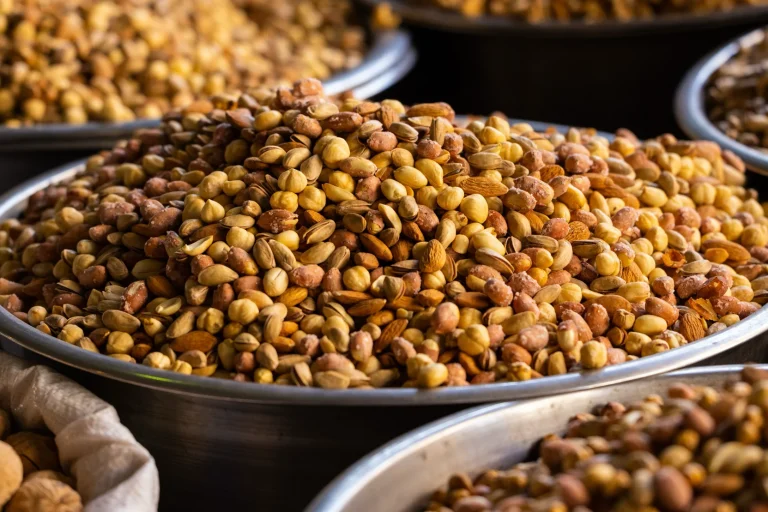
The highest-fibre snacks by weight are chia seeds, air-popped popcorn, roasted chickpeas, and almonds, not most of the bars marketed as “high fibre.” Under UK and EU nutrition labelling rules, a food only needs 6g of fibre per 100g, or 3g per 100 kcal, to legally carry a “high fibre” claim, a bar much lower than most people assume.
This guide covers what actually has a meaningful amount of fibre, where the “high fibre” label can be misleading, and a few easy swaps for common snacks.
| Key takeaways | |
|---|---|
|
Table of Contents
What “high fibre” actually means on a label
Under UK and EU nutrition claim rules, a food can be labelled “source of fibre” at 3g per 100g, and “high fibre” at 6g per 100g (or 3g per 100 kcal). Both thresholds are lower than most people assume when they see the words on packaging.
That doesn’t make the claim false. It means “high fibre” on a label is a regulatory minimum, not necessarily the best available option in that category. Comparing the actual grams per serving, not just the presence of the claim, is the more useful approach.
Fibre content: whole-food snacks compared
| Snack | Typical serving | Approx. fibre |
|---|---|---|
| Chia seeds | 1 tbsp (15g) | ~5g |
| Air-popped popcorn | 30g (large handful) | ~4g |
| Roasted chickpeas | 40g | ~3g |
| Almonds | 30g (small handful) | ~3.5g |
| Raspberries | 125g punnet | ~8g |
| Pear (with skin) | 1 medium | ~4.5g |
| Oatcakes | 2 cakes | ~2g |
| Edamame (in pod) | 100g | ~5g |
Figures are approximate and vary by brand and preparation. The pattern that matters is consistent: whole plant foods with the skin, husk, or pod intact tend to deliver more fibre per gram than most processed snack alternatives.
Where “high fibre” packaging can be misleading
Many bars and cereal-based snacks reach their “high fibre” claim through added isolated fibre, usually inulin or chicory root fibre, rather than from the base ingredients themselves.
This is not a trick. Isolated inulin is a genuine prebiotic fibre, and our guide to prebiotic fibre covers the evidence behind it. The distinction is that whole-food fibre sources also bring polyphenols, micronutrients, and water content that isolated fibre added to a processed bar does not replicate.
A useful check: look at the ingredients list, not just the front-of-pack claim. If fibre appears mainly as an added ingredient near the bottom of a long list, the product is likely closer to a fortified snack than a naturally high-fibre food.
Easy high fibre snack combinations
- Pear with a small handful of almonds
- Hummus with carrot and pepper sticks
- Oatcakes with nut butter
- Apple with peanut butter, skin on
- Plain popcorn with nutritional yeast instead of butter
- A small tin of edamame or roasted chickpeas kept at your desk
Rotating which of these you reach for week to week also builds toward plant variety, not just fibre volume. Chickpeas, almonds, and berries are three separate plants before you’ve counted anything else you eat that day. Snacks are one piece of the puzzle: for ideas on starting the day with a genuinely high-fibre breakfast, see our guide to high fibre breakfast ideas.
Snacking, bloating, and going too fast
Increasing fibre intake quickly, including through snacks, is one of the most common causes of temporary gas and bloating. Your gut bacteria need time to adjust to a higher fibre load, and a sudden jump from low-fibre snacks to several high-fibre ones in the same week can cause noticeable discomfort.
Building up gradually over two to three weeks, rather than switching everything at once, tends to avoid this. For a deeper look at what causes bloating and which probiotic strains have evidence for reducing it, see our guide to probiotics for bloating.
It is also worth knowing that some high-fibre snacks, particularly apples, pears, and legumes, are higher in fermentable carbohydrates (FODMAPs) that can trigger symptoms in people with diagnosed IBS. Our guide to prebiotics and IBS covers which fibre sources tend to be better tolerated.
Frequently asked questions
What is the highest fibre snack?
By weight, chia seeds are among the highest, at roughly 5g of fibre per tablespoon. Air-popped popcorn, roasted chickpeas, almonds, and raspberries are also strong options, generally outperforming packaged “high fibre” bars gram for gram.
What legally counts as a “high fibre” snack in the UK?
Under UK and EU nutrition labelling rules, a food can carry a “high fibre” claim at 6g of fibre per 100g, or 3g per 100 kcal. This is a lower threshold than most people expect, so comparing actual grams per serving is more useful than relying on the label claim alone.
Are high fibre bars actually healthy?
Many reach their fibre claim through added inulin or chicory root fibre, which is a genuine prebiotic fibre but doesn’t carry the same accompanying nutrients as whole plant foods. Checking the ingredients list, not just the front-of-pack claim, gives a clearer picture.
Why do high fibre snacks sometimes cause bloating?
Increasing fibre intake quickly gives your gut bacteria more to ferment than they are used to, which can produce temporary gas and bloating. This typically settles as your gut adjusts, usually within a couple of weeks of gradual, consistent intake.
Are high fibre snacks suitable for people with IBS?
It depends on the source. Some high-fibre foods, particularly apples, pears, and legumes, are also high in FODMAPs and can trigger IBS symptoms. Lower-FODMAP high-fibre options, such as oats, chia seeds, and firm bananas, are generally better tolerated.
What is a quick high fibre snack with no preparation?
A small handful of almonds, a punnet of raspberries, or a pre-cooked pouch of edamame all require no preparation and provide a meaningful amount of fibre, roughly 3 to 8g depending on the option and portion.
References
- Regulation (EC) No 1924/2006 of the European Parliament and of the Council on nutrition and health claims made on foods (retained in UK law), Annex, “source of fibre” and “high fibre” claim conditions.
- Slavin J. Fiber and prebiotics: mechanisms and health benefits. Nutrients. 2013;5(4):1417-1435. PMC
Fibre values are approximate and vary by brand, ripeness, and preparation method. This article is for informational purposes only and does not constitute medical advice. If you have IBS or another diagnosed digestive condition, speak with your GP or a registered dietitian before making significant dietary changes.
Find our guides useful? Add Epsilon Life as a preferred source on Google to see more of them in your search results.
Add to Google preferred sources