


Short answer: the live cultures with the strongest clinical evidence for IBS are strain-specific, not brand-specific. For IBS-D, research most supports Saccharomyces boulardii and Lactobacillus plantarum 299v. For bloating, Bifidobacterium infantis 35624 (now classified as B. longum 35624, sold in the UK as Alflorex) has the best trial data. For IBS-C, the evidence is thinner, but Bifidobacterium lactis DN-173 010 has been shown to speed up gut transit. The strain number on the label, not the CFU count, is what links a product to real evidence.
If you search for the best live cultures for IBS in the UK, you will find dozens of products making bold claims and very little clarity about which strains actually have trial data behind them. Most over-the-counter products contain strains that have never been tested in people with IBS.
This guide cuts through the noise. It covers the specific strains with published trial data for each IBS subtype, a like-for-like comparison of the main UK products, what UK guidance actually says, and why the delivery format may matter as much as the strain itself.
Key takeaways
- Benefits are strain-specific. Two products with the same species can behave completely differently.
- The strongest IBS-D evidence is for S. boulardii and L. plantarum 299v.
- The single most-tested IBS strain, B. infantis 35624, is sold in the UK as Alflorex.
- IBS-C has the least strain-specific evidence of the three subtypes.
- NICE advises trying any probiotic for at least four weeks before judging it.
- A bigger CFU number is not better. The landmark trials used around 100 million CFU.
Table of Contents
Why Strain Matters More Than Brand
Not all live culture products are the same. Two products can both contain Lactobacillus species and have completely different effects, because benefits are strain-specific, not species-specific.
A 2018 meta-analysis in Alimentary Pharmacology & Therapeutics (Ford et al.) reviewed 53 randomised controlled trials covering over 5,500 IBS patients. The overall finding was a modest benefit for live cultures as a group, but results varied enormously by strain.
This means “contains 10 billion CFU of 15 strains” tells you almost nothing useful. What matters is whether the specific strains in the product have been tested in IBS populations, and at what dose.
Best Strains for IBS-D (Diarrhoea-Dominant)
If loose stools and urgency are your main symptoms, these are the strains with the strongest evidence.
Saccharomyces boulardii
This is a beneficial yeast, not a bacterium. A 2015 systematic review in World Journal of Gastroenterology found it may reduce diarrhoea frequency in IBS-D patients. Because it is a yeast, it is not affected by antibiotics, which makes it useful if you are taking them at the same time. You can read more in our guide to Saccharomyces boulardii.
Lactobacillus plantarum 299v
Multiple randomised trials have shown this strain may reduce abdominal pain, bloating, and stool frequency in IBS patients. A 2012 trial in World Journal of Gastroenterology (Ducrotté et al.) found significant improvements in pain and bloating scores after four weeks. This is one of the most consistently positive strains in IBS research. More detail is in our guide to Lactobacillus plantarum.
Bifidobacterium infantis 35624
Tested specifically in IBS populations by Whorwell et al. (2006) in the American Journal of Gastroenterology. At a dose of 10⁸ CFU (100 million), it significantly reduced pain, bloating, and bowel movement difficulty compared with placebo. Higher doses were no more effective, which suggests the benefit is about the strain, not the volume. This strain has since been reclassified as Bifidobacterium longum 35624 and is sold in the UK as Alflorex.
Best Strains for IBS-C (Constipation-Dominant)
Fewer strains have been tested specifically for IBS-C, but there is evidence for a couple.
Bifidobacterium lactis DN-173 010
This strain, found in some fermented dairy products, has been shown to reduce gut transit time. A 2009 meta-analysis found it shortened colonic transit by an average of 12 hours, which is meaningful for people with slow-transit constipation.
Lactobacillus rhamnosus GG
One of the most-researched strains overall, Lactobacillus rhamnosus GG has shown benefits across multiple gut conditions. For IBS-C specifically, the evidence is more mixed than for IBS-D, but it may help with overall symptom burden and has a strong safety profile.
Best Strains for IBS-M (Mixed)
IBS-M, where bowel habits swing between diarrhoea and constipation, is the hardest subtype to target because most trials recruited either IBS-D or IBS-C patients, not mixed.
The practical approach is to focus on strains that act on the symptoms you have most often, rather than chasing a single mixed-type product. Two options have broad, multi-symptom evidence that suits fluctuating symptoms.
Lactobacillus plantarum 299v has trial data for pain and bloating that applies regardless of stool pattern, which makes it a reasonable starting point for IBS-M. Multi-strain fermented formats are also worth considering, because they act on the wider gut environment rather than pushing transit in one direction. If your pattern shifts week to week, track which symptoms dominate and match the strain to those, and give any product a full four weeks before deciding.
Best Strains for IBS and Bloating
Bloating is the most common IBS complaint, regardless of subtype. The strains with the most evidence for reducing IBS bloating specifically are Bifidobacterium infantis 35624 and Lactobacillus plantarum 299v. Both showed significant bloating reduction in their respective trials.
Lactobacillus casei has also shown some promise in combination formulations, though the evidence for it as a standalone strain in IBS is weaker. Our guide to probiotics for bloating covers this in more detail.
Best Probiotics for IBS in the UK: How the Main Products Compare
Most UK IBS shortlists feature the same handful of products. Here is how they compare on the things that actually link to evidence: named strains, dose, and format. The table lists what each brand publishes about its own composition. It is not a ranking of effectiveness, and no product here is a treatment for IBS.
| Product | Format | Strains named on label | Stated dose | Storage |
|---|---|---|---|---|
| Alflorex (PrecisionBiotics) | Capsule | B. longum 35624 (single strain, strain code given) | 1 billion CFU | Room temperature |
| Symprove Original | Water-based liquid | L. rhamnosus, E. faecium, L. plantarum, L. acidophilus (4, species-level) | Not disclosed per dose | Refrigerate |
| Bio-Kult Everyday | Capsule | 14 strains (species-level) | 2 billion CFU/capsule | Room temperature |
| Optibac Every Day EXTRA | Vegan capsule | L. acidophilus NCFM plus others | 20 billion CFU | Room temperature |
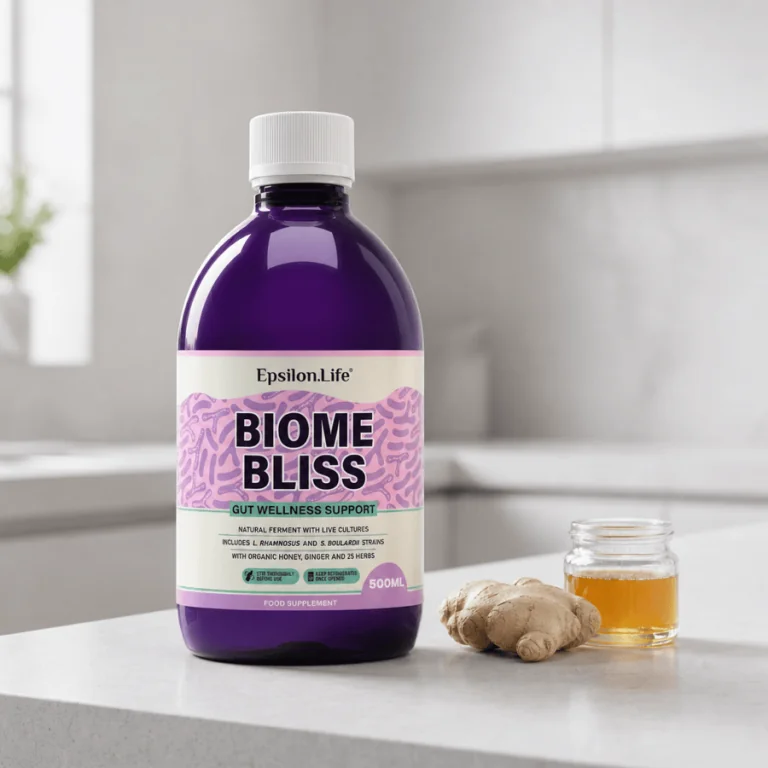
| Biome Bliss (Epsilon Life) | Naturally fermented liquid | L. plantarum, L. rhamnosus, S. boulardii, L. casei, P. freudenreichii, S. thermophilus (6, species-level) | 100 million CFU/serving | Fridge after opening |
Compositions as published by each brand and believed correct at the time of writing. Always check the current label, as formulations change. This table compares publicly available product information to help you read labels; it is not a ranking of effectiveness or a recommendation of one product over another.
A few things are worth understanding when you read a label like this. A higher CFU number does not mean stronger IBS evidence: the landmark trials used modest doses of around 100 million CFU. Some products carry direct IBS trial data, for example Alflorex, whose single strain is the B. infantis/longum 35624 tested by Whorwell, and Bio-Kult, whose whole 14-strain formula was tested in an IBS-D trial (Ishaque et al., 2018). Others list their cultures only at species level, which is standard for many fermented and multi-strain products but means you cannot map them directly to a specific strain trial.
Capsule vs Fermented Format: Does It Matter?
This is where things get interesting. Most UK products come as freeze-dried capsules containing isolated strains. But a 2018 study in Cell (Suez et al.) found that standard multi-strain capsules actually delayed microbiome recovery after antibiotics, compared with natural recovery.
The likely reason: isolated strains in a capsule behave differently to live cultures delivered within a fermented food or supplement matrix. A naturally fermented product contains not just the live bacteria but also the organic acids, postbiotic compounds, and metabolic byproducts produced during fermentation. This more closely mirrors how humans have consumed beneficial microbes for thousands of years.
For IBS specifically, the gut environment is already compromised. A delivery format that supports the broader ecosystem, rather than just adding isolated organisms, may be more appropriate.
What NICE and the NHS Say About Probiotics for IBS
UK guidance is cautiously supportive rather than prescriptive. NICE guidance on IBS in adults advises that if you choose to try a probiotic, take it for at least four weeks at the dose the manufacturer recommends, while monitoring the effect. If there is no improvement, stop and try a different one.
The NHS and the British Dietetic Association both note that evidence for probiotics in IBS is promising but strain-dependent, which is exactly why a named strain matters more than a brand name. Neither body endorses a specific product. If your symptoms are new, severe, or changing, UK guidance is clear that you should see your GP before self-treating, to rule out other conditions.
How to Choose the Best Live Culture Supplement for IBS in the UK
When choosing a live culture supplement for IBS in the UK, focus on these criteria:
- Named strains, not just species. “Contains Lactobacillus plantarum” is not the same as “Contains Lactobacillus plantarum 299v.” The strain number is what links to the clinical evidence.
- Appropriate CFU count, not maximum. The landmark IBS trials used doses of around 10⁸ CFU (100 million). The Whorwell trial found higher doses were no more effective. Mega-dose products (50 billion and up) are not better supported by IBS-specific evidence.
- Evidence for your subtype. IBS-D and IBS-C respond to different strains. A generic gut health product may not address your specific symptoms.
- Delivery format. Consider whether a naturally fermented format might suit you better than a standard capsule, particularly if you have tried capsules before without benefit.
- Storage requirements. Some strains require refrigeration to remain viable. Check the label.
Supporting Your Gut with Biome Bliss
Biome Bliss takes a different approach to most UK gut health supplements. Rather than freeze-drying isolated strains into a capsule, it delivers six live cultures, including Lactobacillus plantarum, Lactobacillus rhamnosus, and Saccharomyces boulardii, within a naturally fermented base of organic honey, apple juice, and 25 organic herbs. You can see the full ingredient breakdown here.
To be clear about the label: like most fermented products, Biome Bliss lists its cultures at species level rather than by individual strain code. So its case does not rest on carrying a specific trialled strain such as L. plantarum 299v. It rests on the delivery format, a fermented matrix that also provides organic acids and postbiotic compounds, and on a measured dose.
At 100 million CFU per serving, it is formulated at the dose used in the landmark IBS trials, not inflated to compete on label numbers. For people who have been disappointed by high-dose capsule formats, the delivery difference is worth considering.
Frequently Asked Questions
What is the best live culture supplement for IBS in the UK?
The best option depends on your IBS subtype. For IBS-D, research supports Saccharomyces boulardii and Lactobacillus plantarum 299v most strongly. For bloating, Bifidobacterium infantis 35624 (sold as Alflorex) has the most trial data. Look for products that name specific strains, not just species.
Which probiotic is best for IBS-M (mixed type)?
IBS-M has the least subtype-specific research. A sensible approach is to match the strain to whichever symptoms dominate most weeks, and to consider multi-symptom strains like L. plantarum 299v that have evidence for pain and bloating regardless of stool pattern. Give any product four weeks before judging it.
Can probiotics make IBS worse?
Some people notice more wind or bloating in the first week or two as the gut adjusts, which usually settles. If symptoms clearly worsen and stay worse beyond two weeks, that strain or format may not suit you, and it is worth stopping and trying a different one. Introducing one product at a time makes it easier to tell what is happening.
Do live cultures help with IBS bloating?
Research shows certain strains may reduce IBS bloating. Bifidobacterium infantis 35624 and Lactobacillus plantarum 299v both showed significant bloating improvements in randomised trials. Generic multi-strain products without these specific strains may not have the same effect.
Should I take different strains for IBS-D vs IBS-C?
Different subtypes respond to different strains. IBS-D has the most evidence, particularly for Saccharomyces boulardii and L. plantarum 299v. IBS-C has fewer strain-specific trials, but Bifidobacterium lactis DN-173 010 has shown transit time benefits.
How long should I take live culture supplements for IBS?
Most IBS trials ran for four to eight weeks before measuring outcomes, and NICE advises trying any probiotic for at least four weeks. Give a new supplement at least that long before judging it. If you see no improvement after eight weeks, the strain or format may not be right for your symptoms.
References
- Ford AC et al. Efficacy of prebiotics, probiotics, and synbiotics in irritable bowel syndrome and chronic idiopathic constipation: systematic review and meta-analysis. Alimentary Pharmacology & Therapeutics. 2018;48(10):1044-1060. PubMed
- Ducrotté P et al. Clinical trial: Lactobacillus plantarum 299v (DSM 9843) improves symptoms of irritable bowel syndrome. World Journal of Gastroenterology. 2012;18(30):4012-4018. PubMed
- Whorwell PJ et al. Efficacy of an encapsulated probiotic Bifidobacterium infantis 35624 in women with irritable bowel syndrome. American Journal of Gastroenterology. 2006;101(7):1581-1590. PubMed
- Suez J et al. Post-antibiotic gut mucosal microbiome reconstitution is impaired by probiotics and improved by autologous FMT. Cell. 2018;174(6):1406-1423. PubMed
- Ishaque SM et al. A randomized placebo-controlled clinical trial of a multi-strain probiotic formulation (Bio-Kult) in the management of diarrhoea-predominant irritable bowel syndrome. BMC Gastroenterology. 2018;18(1):71. PubMed
- National Institute for Health and Care Excellence. Irritable bowel syndrome in adults: diagnosis and management (CG61). NICE
This article is for informational purposes only and does not constitute medical advice. If your IBS symptoms are severe, worsening, or accompanied by weight loss, rectal bleeding, or fever, see your GP for assessment before starting supplementation.
Find our guides useful? Add Epsilon Life as a preferred source on Google to see more of them in your search results.
Add to Google preferred sources