


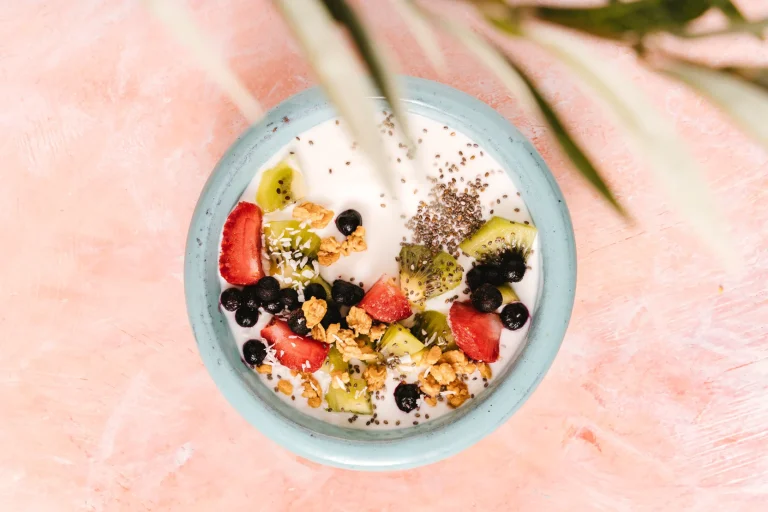
A genuinely high fibre breakfast needs at least 6 to 8g of fibre, roughly a quarter of the NHS’s 30g daily target, and it is more reliably hit with oats, chia, and fruit than with most cereals marketed as “high fibre.” Many popular UK breakfast cereals contain closer to 2 to 3g of fibre per 30g serving, despite front-of-pack messaging.
This guide covers what a high fibre breakfast actually needs, six combinations that genuinely hit the mark, and a couple of details most breakfast advice misses entirely.
| Key takeaways | |
|---|---|
|
Table of Contents
Why breakfast is a good place to front-load fibre
Breakfast tends to be the most controllable meal of the day. Fewer variables, less time pressure than a rushed lunch, and no social eating to navigate, which makes it easier to consistently hit a fibre target here than at other meals.
It also matters because a low-fibre breakfast, white toast, most cereals, a pastry, sets a low baseline that is genuinely hard to recover from later in the day without deliberate effort at both remaining meals.
What a high fibre breakfast actually needs
The NHS recommends 30g of fibre per day for adults. Most people in the UK get closer to 20g. Splitting that target roughly across three meals puts breakfast at around 6 to 8g, a genuinely useful benchmark to aim for.
| Breakfast component | Typical serving | Approx. fibre |
|---|---|---|
| Porridge oats (dry) | 40g | ~4g |
| Chia seeds | 1 tbsp | ~5g |
| Ground flaxseed | 1 tbsp | ~2g |
| Hemp seeds | 1 tbsp | <0.5g |
| Mixed berries | 80g | ~3g |
| Wholemeal toast | 2 slices | ~4g |
| Baked beans | half a 415g tin | ~7g |
| Average “high fibre” cereal | 30g bowl | ~2-3g |
Six high fibre breakfast combinations
- Overnight oats with chia and berries. Oats, a tablespoon of chia seeds, and a handful of mixed berries soaked overnight in milk or a plant alternative. Around 10 to 12g of fibre in one bowl.
- Beans on wholemeal toast. An unfashionable but genuinely high-fibre UK breakfast staple. Roughly 11g of fibre between the two components.
- Wholemeal toast with avocado and seeds. Wholemeal bread and half an avocado, topped with a mix of pumpkin and sunflower seeds. Around 8 to 9g of fibre.
- Greek yoghurt with high-fibre granola and fruit. Choosing a granola with visible whole oats, nuts, and seeds rather than mostly refined grain and sugar clusters. Around 6 to 8g depending on the brand.
- A vegetable and fruit smoothie with added seeds. Spinach, a banana, mixed berries, and a spoonful of chia or flaxseed blended together. Around 8 to 10g of fibre, more if extra vegetables are added.
- Greek yoghurt with a chia, flax and hemp seed mix, plus berries. A tablespoon each of chia and ground flaxseed does most of the fibre work here, around 6 to 7g combined, while hemp seeds contribute protein and omega-3s rather than meaningful extra fibre. Berries add another 2 to 3g on top. No cooking required, which makes it an easy one to keep in rotation.
Rotating between these across the week also builds toward 30 plants a week without any extra effort. A smoothie alone can bank three or four different plants in one glass. Pairing breakfast with a couple of the ideas in our high fibre snacks guide covers the rest of the day.
A detail most breakfast advice misses: resistant starch
Cooking destroys resistant starch, a prebiotic fibre type that feeds beneficial gut bacteria. Cooling cooked starchy foods afterwards partially restores it through a process called retrogradation.
Practically, this means porridge made the night before and eaten cold, or reheated from the fridge, contains slightly more resistant starch than porridge eaten fresh off the hob. The difference is modest, but it is a genuine mechanism, not a wellness myth. Our guide to prebiotic fibre covers resistant starch and the other prebiotic fibre types in more depth.
Sprouts: a nutrient boost when fresh veg is short
Broccoli sprouts specifically aren’t a major fibre source on their own. A typical handful adds well under a gram, so they’re not a substitute for the combinations above. They’re worth keeping in the fridge anyway, for mornings when fresh vegetables are otherwise thin on the ground.
Research on broccoli sprouts has focused less on fibre and more on glucosinolates, compounds present at substantially higher concentrations in young sprouts than in mature broccoli (Fahey et al., 1997). They pair well with scrambled or fried eggs, need no preparation, and add to the plant variety count covered in our guide to 30 plants a week.
Make-ahead options if you don’t eat first thing
Not everyone wants to eat immediately on waking. If your routine is a lighter meal later in the morning, at your desk or otherwise, most of the combinations above hold up well made in advance.
Overnight oats, chia pudding, and a pre-mixed seed-and-yoghurt pot all keep well in the fridge for a day or two, ready to eat cold or brought along as a packed light lunch rather than a first-thing breakfast. Hard-boiled eggs also store well for a few days if you want the egg-and-sprouts combination without the morning assembly.
Sprouts are the one component better added just before eating rather than mixed in ahead of time. They hold their texture and nutrient content best fresh, so keep them separate and add them at the point of eating even if everything else is prepped.
If you take Biome Bliss on an empty stomach first thing, this still works whether your actual meal follows immediately or a few hours later.
Pairing breakfast with a gut health routine
A high-fibre breakfast and a daily probiotic serve different but complementary roles: fibre feeds the bacteria already in your gut, while Biome Bliss introduces live, studied strains alongside its own prebiotic and postbiotic compounds.
Biome Bliss is typically taken first thing in the morning on an empty stomach, which makes it easy to build into the same routine as a high-fibre breakfast rather than as a separate habit to remember.
Frequently asked questions
How much fibre should a high fibre breakfast have?
Aim for roughly 6 to 8g, about a quarter of the NHS’s 30g daily fibre target. Porridge with chia and berries, or beans on wholemeal toast, both comfortably reach this, while many boxed cereals fall well short despite “high fibre” labelling.
Why don’t high fibre cereals always have much fibre?
UK and EU labelling rules allow a “high fibre” claim at just 6g per 100g. Once portioned into a typical 30g bowl, that can work out to only 2 to 3g of actual fibre, less than a single tablespoon of chia seeds.
Is beans on toast actually a good high fibre breakfast?
Yes. Half a tin of baked beans with two slices of wholemeal toast provides roughly 11g of fibre, making it one of the higher-fibre traditional UK breakfasts, despite not being marketed as a health food.
Does cold porridge really have more fibre than hot porridge?
Cooling cooked oats slightly increases their resistant starch content through a process called retrogradation. The effect is modest but genuine, and resistant starch is a prebiotic fibre type that feeds beneficial gut bacteria.
What is the easiest way to add fibre to breakfast without changing what I eat?
Adding a tablespoon of chia or ground flaxseed to whatever you already eat, porridge, yoghurt, or a smoothie, adds roughly 4 to 5g of fibre with minimal change to your routine.
Can I meal prep a high fibre breakfast?
Yes. Overnight oats, chia pudding, and pre-mixed seed-and-yoghurt pots all keep well in the fridge for a day or two, making them practical for a packed light meal later in the morning rather than an immediate first-thing breakfast.
Are broccoli sprouts a good source of fibre?
Not particularly. A typical serving adds well under a gram of fibre. They’re more valuable for glucosinolate compounds, present at much higher levels in sprouts than in mature broccoli, and are a useful plant-variety addition on days when fresh vegetables are limited.
Can a high fibre breakfast cause bloating?
It can, particularly if your usual breakfast is low in fibre and you increase intake suddenly. Building up gradually over a week or two, rather than switching all at once, generally avoids this.
References
- Alfa MJ et al. A randomized trial to determine the impact of a digestion resistant starch composition on the gut microbiome in older and mid-age adults. Clinical Nutrition. 2018;37(3):797-807. PMC
- Slavin J. Fiber and prebiotics: mechanisms and health benefits. Nutrients. 2013;5(4):1417-1435. PMC
- Fahey JW, Zhang Y, Talalay P. Broccoli sprouts: an exceptionally rich source of inducers of enzymes with high glucosinolate content. Proceedings of the National Academy of Sciences. 1997;94(19):10367-10372. pubmed.ncbi.nlm.nih.gov/9294217
Fibre values are approximate and vary by brand and preparation method. This article is for informational purposes only and does not constitute medical advice. If you have digestive symptoms or a diagnosed gut condition, speak with your GP before making significant dietary changes.
Find our guides useful? Add Epsilon Life as a preferred source on Google to see more of them in your search results.
Add to Google preferred sources