



N-acetyl cysteine (NAC) is best known for its role as a glutathione precursor — it supplies cysteine, the rate-limiting amino acid your cells need to produce glutathione. But the value of glutathione depends not just on how much your body makes, but on how effectively it works once it’s been produced.
That’s where selenium and molybdenum become relevant. These two trace minerals play specific, mechanistically distinct roles in glutathione function — roles that make them logical companions to NAC supplementation.
This article explains exactly how they work, what the research shows, and why combining NAC with selenium and molybdenum may offer more complete support for your body’s glutathione system than NAC alone.
Table of Contents
A Quick Recap: What NAC Does
NAC is a stable, bioavailable form of cysteine. Once absorbed, NAC is converted to cysteine, which cells use as the primary building block for glutathione synthesis. Because cysteine is the rate-limiting precursor — the factor most likely to constrain how much glutathione your cells can produce — providing it via NAC is an efficient way to support glutathione levels.
NAC has an extensive evidence base supporting this mechanism. It is used clinically as the standard treatment for paracetamol overdose (which depletes hepatic glutathione), and decades of research have documented its effects on intracellular GSH. For a full overview, see our NAC supplement guide.
What Selenium Does in the Glutathione System
Selenium’s role is not in producing glutathione — it is in recycling it.
When a glutathione molecule (GSH) neutralises a free radical, it becomes oxidised glutathione (GSSG) — a spent, inactive form. For glutathione to remain useful, GSSG must be continuously converted back to active GSH. This recycling is carried out by a family of enzymes called glutathione peroxidases (GPx), and all of them require selenium as an essential cofactor.
Glutathione peroxidases are selenoproteins — proteins that contain selenium as a structural component, not merely as an incidental mineral. Without adequate selenium, these enzymes cannot function properly, which means that even if NAC successfully raises glutathione production, the recycling process breaks down. GSSG accumulates; active GSH falls.
This has been confirmed in population research: selenium deficiency is consistently associated with reduced glutathione peroxidase activity, and selenium supplementation restores it. Interestingly, selenium status also affects the expression of the GPx genes themselves — not just the enzymes’ activity.
The UK reference nutrient intake for selenium is 75µg per day for men and 60µg for women. Studies suggest that many people in the UK and wider Europe have suboptimal selenium status, making this a genuine gap in many people’s nutrition.
What Molybdenum Does in the Glutathione System
Molybdenum’s role is less widely known but equally specific. It is required as a cofactor for an enzyme called sulphite oxidase.
Here is why this matters in the context of NAC: NAC contains sulphur. When your body metabolises NAC and converts it to cysteine — and when cysteine is used in various metabolic processes — one of the byproducts is sulphite. Sulphite is a potentially reactive compound that the body needs to efficiently clear.
Sulphite oxidase converts sulphite to sulphate, which is benign and easily excreted. This enzyme is entirely dependent on molybdenum. Without adequate molybdenum, sulphite clearance slows — which could be particularly relevant for individuals supplementing NAC at meaningful doses over extended periods.
Molybdenum is also a cofactor for xanthine oxidase and aldehyde oxidase — enzymes involved in purine metabolism and drug clearance respectively — though these roles are less directly connected to NAC metabolism.
Molybdenum deficiency in otherwise healthy people is rare, as the mineral is found in legumes, wholegrains, and leafy vegetables. However, the amounts present in a typical diet are modest, and ensuring adequate intake alongside NAC supplementation represents good nutritional practice.
The Case for Combining All Three
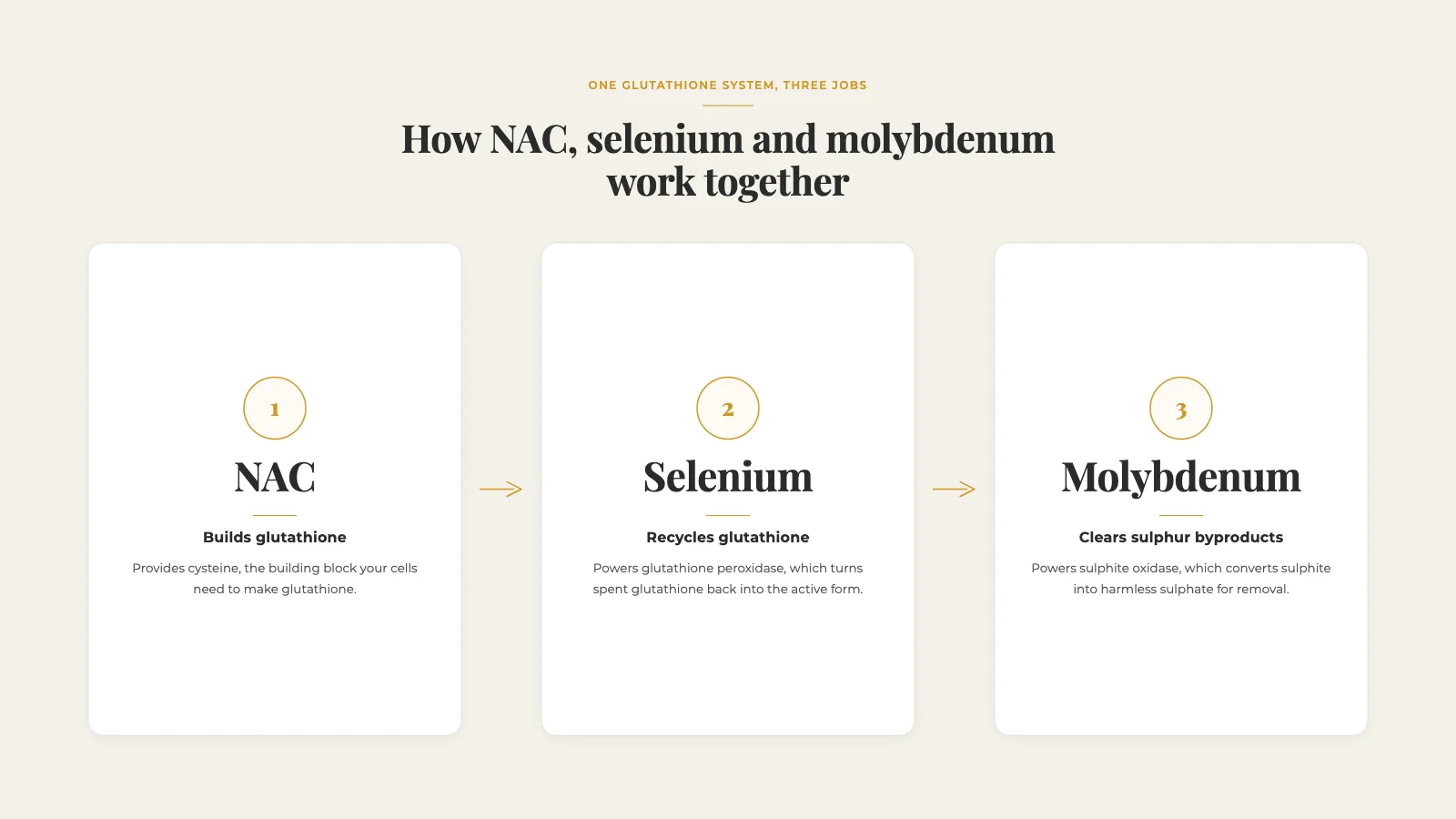
To summarise the mechanisms:
- NAC → provides cysteine → supports glutathione production
- Selenium → activates glutathione peroxidase → supports glutathione recycling
- Molybdenum → activates sulphite oxidase → supports clearance of sulphur byproducts from NAC and cysteine metabolism
These are three distinct, non-overlapping functions. NAC alone addresses only one of the three. A formulation that combines all three provides a more complete approach to supporting the glutathione system — both upstream (synthesis) and downstream (recycling and metabolic clearance).
This is not a theoretical argument. Each mechanism is supported by established biochemistry. The specific question of whether a combined NAC + selenium + molybdenum formulation produces measurably better outcomes than NAC alone has not been studied in a clinical trial — that kind of research rarely happens for micronutrient combinations — but the rationale is clear and grounded in well-understood physiology.
Our NAC+ is our improved formula built on exactly this rationale, combining 600mg N-acetyl cysteine with selenium and molybdenum in one capsule. Vegan-certified and made in the UK.
What About Other Glutathione Cofactors?
Selenium and molybdenum are not the only cofactors relevant to glutathione. Riboflavin (vitamin B2) is required by glutathione reductase, the enzyme that also helps convert GSSG back to GSH (working alongside glutathione peroxidase). Zinc is involved in antioxidant defence via superoxide dismutase. Alpha-lipoic acid can regenerate both vitamins C and E and has been studied alongside glutathione pathways.
However, selenium and molybdenum are the most specifically connected to NAC metabolism and the glutathione recycling pathway specifically, and they are the minerals most likely to be in short supply in people who might otherwise be eating a reasonably balanced diet. This is what makes them the natural candidates to pair with NAC.
Dosage Considerations
There are no agreed supplementation guidelines for selenium or molybdenum specifically in the context of NAC use. Based on the general nutritional literature:
- Selenium: 55–200µg per day is commonly studied; the UK RNI is 75µg (men) / 60µg (women). The upper safe level in the UK is 350µg per day — selenium has a narrower therapeutic window than most minerals, so avoiding excessive doses is important
- Molybdenum: the UK Safe Upper Level is 0.6mg (600µg) per day; amounts in supplements are typically well below this at 50–150µg
As with any supplement combination, it is worth discussing with a healthcare provider if you have an existing health condition or take regular medications.
Frequently Asked Questions
Why is selenium added to NAC supplements?
Selenium is required for glutathione peroxidase — the enzyme that converts spent (oxidised) glutathione back to active glutathione. Without adequate selenium, this recycling process is impaired even if NAC successfully increases glutathione production. Combining NAC with selenium supports both the production and the recycling of glutathione.
What does molybdenum have to do with NAC?
NAC and cysteine are sulphur-containing compounds. When your body metabolises them, one of the byproducts is sulphite. Sulphite oxidase — which requires molybdenum — converts sulphite to the harmless sulphate for excretion. Adequate molybdenum ensures this metabolic pathway runs efficiently, which is particularly relevant when supplementing NAC regularly.
Do I need to take selenium and molybdenum with NAC?
They are not strictly required for NAC to work. NAC will still raise intracellular glutathione in the absence of added selenium and molybdenum. However, selenium and molybdenum support different and complementary aspects of the glutathione system — recycling and sulphur clearance respectively — so a formulation that includes all three provides more complete support than NAC alone.
Can I get enough selenium and molybdenum from food?
Selenium can be obtained from diet — Brazil nuts are a particularly rich source, with 2–3 providing the daily requirement. However, selenium content in food varies significantly by soil concentration, and UK and European soils tend to be low in selenium. Many people in the UK have suboptimal selenium status. Molybdenum is more widely available in legumes and wholegrains, making dietary deficiency less common, though amounts are modest.
Is the combination of NAC, selenium, and molybdenum safe?
All three are well-established nutrients used at typical supplemental doses for extended periods without concern. Selenium requires some care — it has a narrower therapeutic window than most minerals, and high-dose supplementation should be avoided. At the doses found in standard supplements (below 200µg selenium per day), the combination is considered safe for most healthy adults. Those with health conditions or taking medications should check with a healthcare provider first.
Find our guides useful? Add Epsilon Life as a preferred source on Google to see more of them in your search results.
Add to Google preferred sources