


Magnesium glycinate is one of the most popular supplements in the UK, and Amazon is where many people buy it. We wanted to know how many of the most visible products give you a label you can actually check.
So on 21 October 2026 we searched “magnesium glycinate” on Amazon.co.uk and checked the labels of the first 20 products in the organic search results. We did not buy or lab-test them. Everything below comes from what each brand prints on its own listing or label, and simple arithmetic on those figures.
Disclosure: we make a magnesium glycinate supplement. Our own product was not in the top 20 results, and we have not named any brand.
Key findings
| Finding | Products |
|---|---|
| Declare magnesium oxide or buffering | 7 of 20 |
| Claim more elemental magnesium than the forms listed can provide | 5 of 20 |
| Don’t state the compound weight, so the claim can’t be checked | 2 of 20 |
| Total | 14 of 20 |
| Contain magnesium stearate | 8 of 20 |
| Contain a flow or bulking agent (magnesium stearate, stearic acid, silicon dioxide or microcrystalline cellulose) | 10 of 20 |
| Pure forms, and the figure adds up | 6 of 20 |
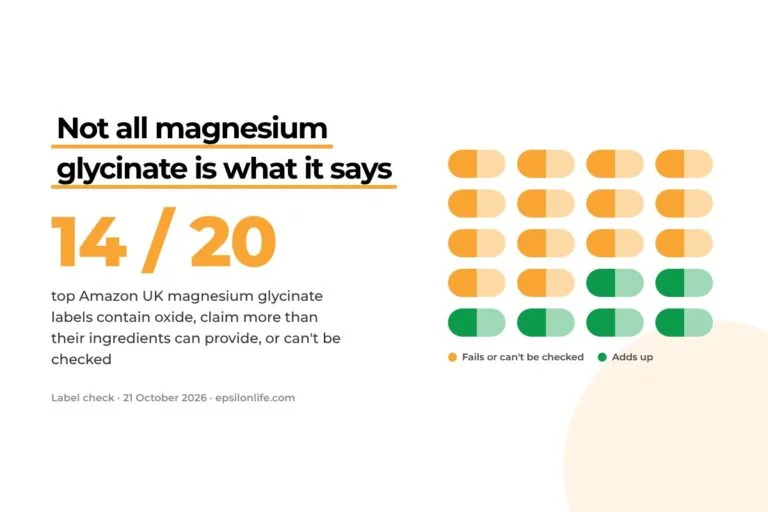
In short: 14 of the top 20 either contain magnesium oxide, claim more magnesium than the ingredients on their label can provide, or don’t give you enough information to check.
Why the numbers on a magnesium label matter
Every magnesium supplement shows two figures: the weight of the compound (for example, 1,500 mg of magnesium glycinate) and the amount of elemental magnesium it provides. Each form of magnesium contains a fixed share of magnesium by weight:
| Magnesium form | Approximate magnesium by weight |
|---|---|
| Magnesium bisglycinate (pure) | Typically about 11% in practice, 14.1% at most in theory |
| Magnesium malate | about 15.5% |
| Magnesium citrate | about 16% |
| Magnesium oxide | about 60% |
Real-world bisglycinate is typically around 11% magnesium (ours is 11%). The 14.1% theoretical maximum is the ceiling we used to check each label, because no glycinate can go above it. If a product lists only glycinate and claims 20% magnesium, the extra cannot come from glycinate. It has to come from something else, and magnesium oxide is the usual way to raise the number. Oxide is cheap and about 60% magnesium, but it has an absorption rate of around 4%.[1]
What we found
The table shows every product, anonymised and grouped by result. “Implied % Mg” is the elemental figure divided by the compound weight, both taken from the brand’s own label.
| Forms on label | Elemental Mg per serving | Compound per serving | Implied % Mg | Oxide or buffering declared | Magnesium stearate | Flow or bulking agent | Result | |
|---|---|---|---|---|---|---|---|---|
| Product A | Glycinate, malate, citrate | 384 mg | 1,800 mg | 21% | No | Yes | Yes | Exceeds listed forms |
| Product B | Glycinate | 315 mg | 1,500 mg | 21% | No | No | No | Exceeds listed forms |
| Product C | Glycinate | 400 mg | 2,000 mg | 20% | No | Yes* | Yes | Exceeds listed forms |
| Product D | Bisglycinate | 208 mg | 1,040 mg | 20% | No | Yes | Yes | Exceeds listed forms |
| Product E | Bisglycinate, malate, citrate | 400 mg | 1,800 mg | 22% | No | No | No | Exceeds listed forms |
| Product F | Bisglycinate with magnesium oxide | 240 mg | Not stated | – | Yes | Yes | Yes | Declares oxide |
| Product G | Bisglycinate (buffered) | 375 mg | 1,875 mg | 20% | Yes | Yes | Yes | Declares buffering |
| Product H | Bisglycinate with magnesium oxide | 300 mg | 1,500 mg | 20% | Yes | No | No | Declares oxide |
| Product I | Bisglycinate with magnesium oxide | 72 mg | 400 mg | 18% | Yes | No | No | Declares oxide |
| Product J | Glycinate chelate (buffered) | 90 mg | 500 mg | 18% | Yes | No | No | Declares buffering |
| Product K | Bisglycinate, citrate (buffered), malate, taurate | 400 mg | 1,700 mg | 23.5% | Yes | No | Yes | Declares buffering |
| Product L | Bisglycinate, malate, citrate, magnesium oxide | 381 mg | 1,836 mg | 20.7% | Yes | Yes | Yes | Declares oxide |
| Product M | Bisglycinate | 240 mg | Not stated | – | No | No | No | Can’t be checked |
| Product N | Bisglycinate | 80 mg | Not stated | – | No | Yes | Yes | Can’t be checked |
| Product O | Glycinate | 200 mg | 1,422 mg | 14.1% | No | No | No | Adds up |
| Product P | Bisglycinate | 120 mg | 855 mg | 14.0% | No | Yes | Yes | Adds up |
| Product Q | Glycinate | 198 mg | 1,520 mg | 13.0% | No | No | No | Adds up |
| Product R | Glycinate | 100 mg | 750 mg | 13.3% | No | No | No | Adds up |
| Product S | Glycinate | 303 mg | 2,750 mg | 11.0% | No | No | No | Adds up |
| Product T | Bisglycinate | 200 mg | 2,000 mg | 10% | No | No | Yes | Adds up |
*Listed as “magnesium salts of fatty acids”, the regulated name for magnesium stearate.
Seven declare oxide or buffering
These labels are honest about it: they list magnesium oxide, or describe the magnesium as “buffered”. But “buffered” doesn’t tell you how much oxide is in the mix. In one product, the declared forms only reach the claimed 400 mg if the buffered citrate is roughly 37% magnesium, more than double what pure magnesium citrate can provide.
Five claim more than their listed forms can provide
These labels list only glycinate, or glycinate with malate and citrate, yet claim 20 to 22% magnesium. Pure glycinate tops out at 14.1%, and malate and citrate at around 16%. On their own labels, the figures do not add up.
Two can’t be checked
These state the elemental magnesium but not how much glycinate it comes from, so there is no way to check the claim from the label.
Six add up
Six labels list pure forms with figures that are possible from those forms. Two of them sit at or just below the 14.1% theoretical maximum, which is possible only with very pure, dry raw material.
How to check any magnesium label
- Find the elemental magnesium figure, not just the compound weight.
- Read the full ingredients list, not just the front of the pack.
- Look for “magnesium oxide” or the word “buffered”.
- Divide the elemental figure by the compound weight. Pure glycinate is typically around 11%, and can’t go above 14.1%.
- Check the other ingredients for flow agents such as magnesium stearate or silicon dioxide, if you prefer to avoid them.
How our own product compares
Our Magnesium Glycinate contains 500 mg of pure magnesium bisglycinate per capsule, giving 55 mg of elemental magnesium (11%). Two capsules give 110 mg. There is no magnesium oxide and no magnesium stearate. An independent test at Campden BRI measured elemental magnesium at 9.2% of the capsule contents, in line with pure bisglycinate.
Our figure per capsule is lower than many in the table. That is what pure glycinate looks like.
Frequently asked questions
What does “elemental magnesium” mean?
What is buffered magnesium glycinate?
Does magnesium stearate matter?
How can I check a magnesium label myself?
Method and limitations
- Search: “magnesium glycinate” on Amazon.co.uk, 21 October 2026.
- Sample: the first 20 unique capsule or tablet products in the organic (non-sponsored) results. We excluded sponsored listings, duplicate pack sizes of the same formula, and one gummy product with incomplete ingredient information.
- Data: ingredients, elemental magnesium and compound weight as shown on each product’s listing text or label image.
- “Exceeds listed forms” means the implied magnesium percentage is higher than the maximum possible for the forms on the label, and no oxide or buffering is declared.
- This is a label check, not a lab test. Listing text and physical labels can differ, and search results change daily.
References
[1] Firoz M, Graber M. Bioavailability of US commercial magnesium preparations. Magnesium Research. 2001;14(4):257-62.
Find our guides useful? Add Epsilon Life as a preferred source on Google to see more of them in your search results.
Add to Google preferred sources