


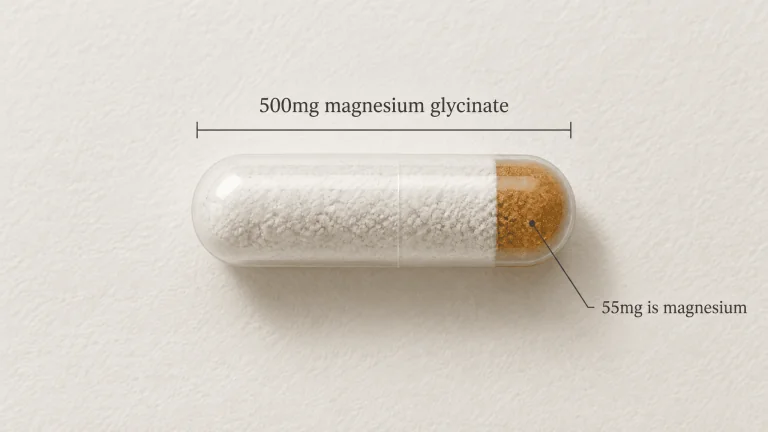
Elemental magnesium is the amount of actual magnesium in a supplement, not the weight of the whole compound it is bound to. A capsule containing 500mg of magnesium bisglycinate does not give you 500mg of magnesium. It gives you about 55mg, because most of that weight is glycine.
That one distinction explains why two magnesium labels can look wildly different, and why the bigger number is not always the better product. This guide shows you how to read the elemental figure on a UK label, how much each form actually contains, and how much you need.
What is elemental magnesium?
Magnesium never appears in a supplement on its own. It is always bonded to something else, such as oxygen (magnesium oxide), citric acid (magnesium citrate) or the amino acid glycine (magnesium glycinate). That partner makes the mineral stable and affects how well you absorb it.
The compound weight is the weight of the magnesium plus its partner. The elemental weight is the magnesium alone. Your body’s requirement, NHS guidance and every safety limit are all expressed in elemental magnesium.
So when you compare products, the compound weight tells you very little. The elemental figure is the one that counts.
Elemental magnesium by form
Each form carries a different share of magnesium by weight. Light partners such as oxygen leave a high percentage. Heavier partners such as glycine or threonic acid leave a lower one.
| Form | Approx. elemental magnesium | Elemental Mg in 500mg of compound |
|---|---|---|
| Magnesium oxide | About 60% | About 300mg |
| Magnesium citrate | About 16% | About 80mg |
| Magnesium malate | About 15% | About 75mg |
| Magnesium glycinate (bisglycinate) | About 11% in practice (14% in theory) | About 55mg |
| Magnesium taurate | About 9% | About 45mg |
| Magnesium L-threonate | About 7 to 8% | About 35 to 40mg |
Figures are approximate and vary with the exact salt and how much water it holds. Always check the elemental figure printed on the label.
Glycinate is a good example of theory versus practice. On paper, the pure compound is about 14% magnesium. The magnesium bisglycinate actually used in supplements typically comes in at around 11%, which is why 500mg of it gives about 55mg of elemental magnesium.
This is why a glycinate capsule will always show a smaller elemental number than an oxide tablet of the same size. It is chemistry, not a weaker product.
How to read elemental magnesium on a UK label
UK supplement labels list nutrients in the nutrition table, usually per capsule or per daily serving. Look for three things.
- The magnesium line in the nutrition table. This should be the elemental figure. Some brands write “Magnesium (from magnesium bisglycinate) 55mg”, which is the clearest format.
- The %NRV next to it. The Nutrient Reference Value for magnesium is 375mg. A product giving 110mg of elemental magnesium shows roughly 29% NRV.
- The ingredients list. This tells you which compounds are inside. If you see magnesium oxide listed next to glycinate, the product is buffered (more on that below).
Be wary of front-of-pack numbers like “Magnesium Glycinate 1000mg”. That is usually the compound weight. It can be accurate and still tell you almost nothing about how much magnesium you are getting.
For the other terms you will see on a supplement label, from NRV to HPMC, see our plain-English supplement glossary.
A quick sense check: if a “pure glycinate” product claims much more than 11% of its glycinate weight as elemental magnesium, and certainly more than the theoretical 14%, something else is in the mix.
Elemental is not the same as absorbed
A high elemental percentage does not mean more magnesium reaches your bloodstream. Absorption, or bioavailability, depends heavily on the form.
Magnesium oxide is the clearest example. It is about 60% elemental magnesium, but a study in Magnesium Research (2001) measured its fractional absorption at around 4%. Much of that large label number passes through your gut unabsorbed, which is also why oxide is linked to loose stools.
Chelated forms such as glycinate carry less magnesium per gram but are generally better absorbed and better tolerated. Our guide to magnesium oxide vs glycinate covers the research in more detail.
So the useful question is not “which label shows the most magnesium?” It is “how much elemental magnesium, in which form?”
Chelated vs elemental magnesium: not opposites
People often search for “chelated vs elemental magnesium” as if they were two competing products. They are not.
“Chelated” describes how the magnesium is bound: to amino acids, as in glycinate. “Elemental” describes how much magnesium is present. A chelated magnesium supplement still has an elemental magnesium figure, it is just lower per gram than oxide.
If you want to understand the chelation side, read our explainer on chelated magnesium.
How much elemental magnesium do you need?
All the official UK figures below refer to elemental magnesium.
- Daily requirement from all sources: the NHS gives 300mg a day for men and 270mg a day for women aged 19 to 64.
- Labelling reference (NRV): 375mg a day. This is the figure used for the %NRV on packs.
- Supplements: the NHS says taking 400mg or less a day from supplements is unlikely to cause any harm. The UK Expert Group on Vitamins and Minerals set the same 400mg supplemental guidance level in 2003.
Most people get a good share of their magnesium from food, so a supplement usually tops up rather than replaces your diet. Our guide to signs of magnesium deficiency can help you judge whether you are likely to be running low.
If you have kidney disease or take prescription medication, speak to your GP or pharmacist before supplementing.
The buffering trick: when the elemental number is inflated
Because glycinate is only about 11% magnesium in practice, a pure glycinate capsule cannot carry a very large elemental dose. Some brands get around this by blending in magnesium oxide, which is cheap and about 60% magnesium.
The result is called buffered magnesium glycinate. The elemental figure on the label goes up, but a large share of it now comes from the poorly absorbed oxide.
The label is not technically wrong. It just does not tell you how much of that magnesium came from glycinate. Check the ingredients list for “magnesium oxide” to find out.
Why our capsules show 55mg elemental
Each capsule of our Magnesium Glycinate contains 500mg of magnesium bisglycinate, which provides 55mg of elemental magnesium. That is the 11% you would expect from pure glycinate. There is no magnesium oxide in the formula.
That number looks modest next to buffered products, and that is the point. It is what a pure, unbuffered glycinate capsule can honestly deliver. Two capsules give you 110mg of elemental magnesium from a well-tolerated form.
You can see the full formula and why we chose it in what’s in our magnesium glycinate.
Frequently asked questions
What does elemental magnesium mean?
Elemental magnesium is the weight of the magnesium itself in a supplement, without the compound it is bound to. For example, 500mg of magnesium glycinate contains about 55mg of elemental magnesium. Daily requirements and safety limits are always given as elemental magnesium.
Is elemental magnesium better than magnesium glycinate?
They are not alternatives. Magnesium glycinate is a form of magnesium, and every form has an elemental magnesium content. Glycinate typically contains about 11% elemental magnesium by weight. What matters is how much elemental magnesium you get and how well that form is absorbed.
How much elemental magnesium is in magnesium glycinate?
The magnesium bisglycinate used in supplements is typically about 11% elemental magnesium, so 1,000mg provides roughly 110mg. The theoretical maximum is about 14%. Our capsules contain 500mg of bisglycinate and 55mg of elemental magnesium. If a product claims much more per gram of glycinate, it likely contains added magnesium oxide.
How much elemental magnesium should I take a day?
The NHS recommends 300mg a day for men and 270mg for women from all sources, including food. It also says 400mg or less a day from supplements is unlikely to cause harm. Most people use a supplement to top up their diet rather than cover the full amount.
Does elemental magnesium cause diarrhoea?
It depends on the form, not the elemental figure. Poorly absorbed forms such as oxide and citrate draw water into the bowel and are more likely to cause loose stools. Glycinate is generally better tolerated. Our guide to magnesium and diarrhoea explains which forms to choose.
References
- Firoz M, Graber M. Bioavailability of US commercial magnesium preparations. Magnesium Research. 2001;14(4):257-262. PubMed
- NHS. Vitamins and minerals: Others (magnesium).
- Regulation (EU) No 1169/2011 on the provision of food information to consumers, Annex XIII (Nutrient Reference Values), as retained in UK law. legislation.gov.uk
- Expert Group on Vitamins and Minerals. Safe Upper Levels for Vitamins and Minerals. Food Standards Agency. 2003.
This article is for informational purposes only and does not constitute medical advice. If you have a medical condition or take medication, speak with your GP or a qualified healthcare practitioner before starting supplementation.
Find our guides useful? Add Epsilon Life as a preferred source on Google to see more of them in your search results.
Add to Google preferred sources