


Dairy-Free Probiotic Drinks: What the Label Doesn’t Tell You
If you’re dairy-intolerant or vegan and looking for a probiotic drink, you’ve probably noticed that most probiotic bacteria have names starting with “Lactobacillus.” That prefix looks like it means dairy — so are probiotics actually safe for you?
The short answer is: most are. But whether a probiotic product is truly dairy-free depends on something most labels don’t mention at all.
Does “Lactobacillus” Mean Dairy?
No. The “lacto” in Lactobacillus refers to lactic acid — not lactose or milk. These bacteria were first identified in dairy environments because they ferment sugars and produce lactic acid, which is why milk curdles into yogurt. But the bacteria themselves are not a dairy ingredient.
Lactobacillus species are found everywhere: in fermented vegetables, sourdough bread, the human gut, and yes, dairy products. The name is taxonomic, not an ingredient declaration.
The Part Most Labels Skip: Growth Media
Here’s where it gets more complicated. To produce probiotic cultures at scale, manufacturers have to grow the bacteria on a substrate — a nutrient-rich medium that feeds the bacteria during cultivation.
Many industrial probiotic producers use dairy-based growth media: whey, milk proteins, or lactose-rich substrates. Even if the final product contains no dairy ingredients, trace amounts of dairy proteins can carry through from the fermentation stage. For people with lactose intolerance, this is often not an issue. For people with a casein (milk protein) allergy, it can be.
A product can truthfully list no dairy ingredients while still having been cultured on dairy substrates. The label tells you what’s in the final product, not how it was made.
The genuinely dairy-free option is a product where the cultures were never near dairy at any stage — grown on plant-based or naturally carbohydrate-rich media from the start.
What About Dairy-Free Yogurt and Kefir?
Dairy-free versions of traditionally dairy products — oat kefir, coconut yogurt, lactose-free dairy yogurt — are a popular choice for people trying to get probiotics from food. They’re worth discussing honestly.
Lactose-free dairy yogurt has lactase enzyme added to pre-digest the lactose. The bacteria are still present and the product is fine for lactose-intolerant people. However, some lactose-free products are ultra-heat treated (UHT) during processing, which kills the bacteria entirely. Always check for a “live cultures” or “active cultures” label on these products — without it, the probiotic benefit may not be there.
Plant-based yogurt and kefir alternatives (oat, coconut, almond) are genuinely dairy-free, but bacterial survival in these substrates is variable. Probiotic strains evolved to thrive in dairy environments. Grown on plant-based substrates, some strains don’t perform as well, and CFU (colony-forming unit) counts in plant-based alternatives are often lower and less standardised than in dairy versions.
This doesn’t mean dairy-free fermented foods aren’t worth eating — they are. But if your goal is a consistent, measurable dose of live cultures, food sources give you less control than a dedicated probiotic product.
What a Genuinely Dairy-Free Probiotic Drink Looks Like
The cleanest dairy-free option is a probiotic drink where the cultures were grown on non-dairy substrates from day one — no dairy removed, no dairy carried through.
Organic honey and organic apple juice, for example, are carbohydrate-rich fermentation substrates that support robust bacterial growth without any allergen risk. The resulting product is dairy-free at every stage: cultivation, fermentation, and formulation.
There’s also a functional advantage here. Honey contains natural prebiotic oligosaccharides that feed the bacteria. Apple juice provides fructose and malic acid, which support a slightly acidic fermentation environment. This isn’t just a clean-label story — it’s a more complete one.
Probiotics, Prebiotics, and Postbiotics: Why the Full Picture Matters
A good probiotic drink does more than deliver live bacteria. It also needs to feed them (prebiotics) and the fermentation process itself generates beneficial compounds that have their own effects (postbiotics).
Probiotics are the live bacteria — the ones that colonise your gut and contribute to microbial balance. Look for established strains with clinical evidence: Lactobacillus rhamnosus, Lactobacillus plantarum, Saccharomyces boulardii, and Lactobacillus casei are among the most studied.
Prebiotics are the non-digestible fibres and compounds that feed beneficial bacteria in your gut. Without an adequate prebiotic environment, probiotic bacteria have less to work with once they arrive. Some probiotic products are simply bacteria in a capsule — the substrate they were grown on gets discarded. A fermented drink retains the substrate, which acts as a natural prebiotic source.
Postbiotics are the metabolic byproducts produced during fermentation: organic acids, short-chain fatty acids, bioactive peptides, and other compounds. Research is catching up with postbiotics — a 2021 consensus statement in Nature Reviews Gastroenterology & Hepatology formally defined postbiotics as a category and noted their potential to support gut barrier function and immune modulation (Salminen et al., 2021). Unlike live bacteria, postbiotics are stable and don’t require the bacteria to survive passage through the digestive tract to have an effect.
A fermented probiotic drink made from scratch — rather than bacteria added to a carrier liquid — naturally contains all three. The fermentation process produces the postbiotics; the substrate provides prebiotics; the live cultures are the probiotics.
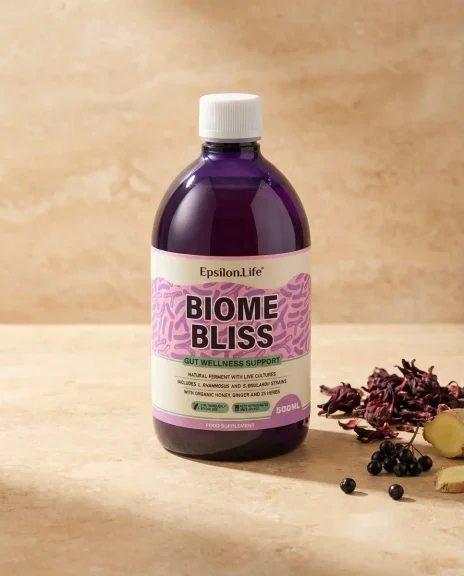
Biome Bliss: A Dairy-Free Probiotic Drink from the Start
Biome Bliss is a 20ml fermented probiotic shot grown on organic honey and organic apple juice. The bacterial cultures were never near dairy at any stage of production — there’s no dairy substrate, no dairy removal, and no allergen crossover.
Because it’s a fermented product rather than a liquid with added bacteria, it naturally contains probiotics, prebiotics, and postbiotics in each shot.
If you’re looking for a dairy-free probiotic drink that’s clean at the ingredient level and the process level, Biome Bliss is designed with exactly that in mind.
Frequently Asked Questions
Are probiotics dairy-free?
Most probiotic bacteria are not inherently dairy — the “lacto” prefix refers to lactic acid production, not milk. However, many probiotic products are cultured on dairy-based growth media during manufacturing. Always check whether the bacteria were grown on dairy or non-dairy substrates, not just the final ingredient list.
Is Lactobacillus safe for people who are lactose intolerant?
Yes, in most cases. Lactobacillus bacteria do not contain lactose. If a product was cultured on dairy-free media, it is safe for lactose-intolerant people. Those with a casein (milk protein) allergy should specifically check the growth media used.
Do dairy-free probiotic yoghurts and kefirs work?
They can, but with caveats. Lactose-free dairy yoghurts may have been heat-treated, killing the bacteria. Plant-based alternatives often have lower and less consistent CFU counts. Check for a “live cultures” label and, where possible, a stated CFU count per serving.
What are postbiotics and why do they matter?
Postbiotics are compounds produced during fermentation, including organic acids and short-chain fatty acids. Research suggests they may support gut barrier function and immune response independently of live bacteria. A fermented probiotic drink naturally contains postbiotics; a probiotic capsule typically does not.
Is a fermented probiotic drink better than a capsule?
For a dairy-free, full-spectrum option, a properly fermented drink has advantages: it retains the prebiotic substrate and produces postbiotics during fermentation. Capsules deliver live bacteria only. Neither is superior in all cases — it depends on the strains, the CFU count, and what you’re trying to support.
Is Biome Bliss suitable for vegans?
Biome Bliss is fermented on organic honey and organic apple juice — both the cultures and the product are dairy-free. Honey is not vegan by strict definition, though it is free from animal-derived allergens. Those following a strict vegan diet should note this.
References
- Salminen S, et al. (2021). The International Scientific Association of Probiotics and Prebiotics (ISAPP) consensus statement on the definition and scope of postbiotics. Nature Reviews Gastroenterology & Hepatology, 18(9), 649–667.
- Hill C, et al. (2014). Expert consensus document: The International Scientific Association for Probiotics and Prebiotics consensus statement on the scope and appropriate use of the term probiotic. Nature Reviews Gastroenterology & Hepatology, 11(8), 506–514.
- Gibson GR, et al. (2017). Expert consensus document: The International Scientific Association for Probiotics and Prebiotics (ISAPP) consensus statement on the definition and scope of prebiotics. Nature Reviews Gastroenterology & Hepatology, 14(8), 491–502.
- Szajewska H & Mrukowicz J. (2001). Probiotics in the treatment and prevention of acute infectious diarrhea in infants and children: a systematic review of published randomized, double-blind, placebo-controlled trials. Journal of Pediatric Gastroenterology and Nutrition, 33(S2), S17–25.
This article is for informational purposes only and does not constitute medical advice. If you have a food allergy, intolerance, or digestive condition, speak to your GP or a registered dietitian before making changes to your supplement routine.