


NAC (N-acetyl cysteine) supplements vary considerably in quality. The molecule itself is well-understood, but how it is formulated, dosed, and manufactured matters significantly for how much benefit you actually get from it. This guide covers what to look for when choosing a NAC supplement in the UK, what the meaningful differences between products are, and what the research says about dosage.
What NAC Does (Briefly)
NAC is a bioavailable form of cysteine — the amino acid your cells need to produce glutathione, the body’s primary intracellular antioxidant. By supplying cysteine, NAC supports glutathione synthesis, which declines with age and is depleted by alcohol, illness, stress, and environmental toxin exposure.
NAC also has direct benefits independent of glutathione: it can thin mucus secretions (making it useful in respiratory conditions), supports liver detoxification, and has been studied for its effects on neurological and metabolic health. For a full overview, see our NAC supplement guide.
What to Look For in a NAC Supplement
Dose per capsule
The most widely studied dose of NAC for general glutathione support is 600mg per day. This is the dose used in many of the foundational studies and is also the standard dose in clinical settings. Some research uses 1,200mg or higher for specific conditions (COPD, liver support), but 600mg is the appropriate starting point for most people.
Look for a product that delivers 600mg per capsule or 600mg per daily serving. Some products offer lower doses (200–400mg) that would require multiple capsules to reach an effective amount, adding unnecessary cost and complexity.
Form of NAC
Most NAC supplements use N-acetyl-L-cysteine — the L-form, which is the biologically active isomer. This is what you want. Products labelled simply “N-acetyl cysteine” or “NAC” should contain the L-form by default, as the D-form is not used in supplementation. However, it is worth checking the label if you are uncertain.
Capsule vs tablet
Capsules (particularly vegetarian or vegan capsules) are generally preferable to tablets for several reasons: they require fewer excipients, they tend to disintegrate more reliably in the gut, and they are easier for the body to process. Tablets often require binding agents and compression aids that add unnecessary ingredients.
NAC has a characteristic sulphurous odour — this is normal and inherent to the molecule. It should not be masked by excessive flavouring agents. A capsule format keeps the product clean and avoids any interaction between flavouring agents and the active compound.
Excipients and fillers
Look at the “other ingredients” list. A quality NAC supplement should contain minimal excipients. Common acceptable ones include:
- HPMC (hydroxypropyl methylcellulose) — standard vegetarian capsule shell
- Microcrystalline cellulose or rice flour — inert flow agents
- Magnesium stearate (in small amounts) or alternative flow agents like silicon dioxide
Be more cautious about products containing artificial colours, unnecessary fillers, or proprietary blends that obscure the actual NAC content. You should always be able to see exactly how much NAC is in each serving.
Vegan / vegetarian certification
Many NAC supplements use plant-based capsules (HPMC) and are suitable for vegans. If this matters to you, look for explicit vegan certification on the label rather than relying solely on ingredient lists, as manufacturing cross-contamination can occur in facilities that also handle animal-derived products.
Third-party testing
The UK supplement market is regulated under food law rather than pharmaceutical standards, which means quality control varies between manufacturers. Third-party testing — where an independent laboratory verifies that the product contains what the label states, and is free from contaminants — is one of the best indicators of a trustworthy product.
Look for certificates of analysis (COAs) available on the manufacturer’s website, or certification from recognised bodies such as Informed Sport (relevant if you are an athlete subject to anti-doping testing) or similar independent testing schemes.
Manufacture standards
Products manufactured to GMP (Good Manufacturing Practice) standards offer greater assurance of quality and consistency. UK-manufactured supplements should comply with UK GMP requirements. Look for this stated on the product or brand’s website.
Additions Worth Considering
Some NAC supplements include additional nutrients that complement NAC’s mechanism. Two worth looking for:
- Selenium — required for glutathione peroxidase, the enzyme that recycles spent glutathione. If NAC supports production but selenium is inadequate, recycling is impaired. Including selenium makes the formulation more complete.
- Molybdenum — required for sulphite oxidase, which clears sulphite — a byproduct of cysteine and NAC metabolism. Adequate molybdenum ensures efficient processing of sulphur compounds from NAC.
For a detailed explanation of why these minerals matter alongside NAC, see our article on NAC with selenium and molybdenum.
What to Avoid
- Undisclosed dosing — any product that does not clearly state the NAC content per capsule or serving should be avoided
- Excessive fillers — products with long lists of unnecessary excipients often indicate lower manufacturing standards
- Very low doses — products providing less than 500mg per serving are unlikely to reach the doses studied in research at a reasonable daily capsule count
- No quality assurance information — if a brand provides no information about testing or manufacturing standards, that is a red flag
- Implausible claims — NAC is a well-researched supplement with a clear mechanism of action. Any product making dramatic or disease-treatment claims (beyond general health support) is making claims that exceed what the evidence supports and may be in breach of UK food supplement regulations
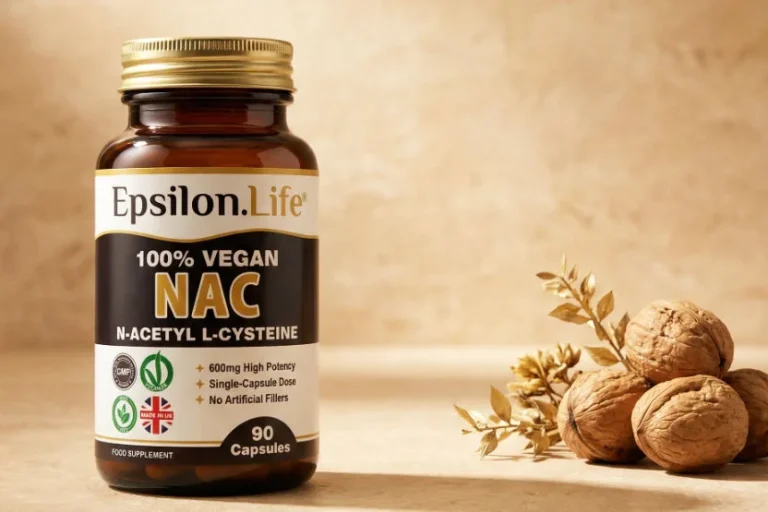
Epsilon Life NAC
Our Epsilon Life NAC provides 600mg of N-acetyl-L-cysteine per vegan capsule, manufactured in the UK to GMP standards. It contains no artificial colours, flavours, or unnecessary fillers. We provide batch-level quality documentation for our products.
Frequently Asked Questions
What is a good dose of NAC to take?
600mg per day is the most widely studied dose for general glutathione support and is appropriate for most adults. Clinical studies for specific conditions (liver support, respiratory health) have used 1,200–1,800mg. If you are new to NAC, starting at 600mg is sensible.
Should I take NAC with food or on an empty stomach?
NAC can be taken either way. Some people find it easier to tolerate with a small amount of food if they are prone to nausea with supplements. There is no strong evidence that food significantly affects NAC absorption at standard doses.
Is NAC safe to take long-term?
NAC has an excellent long-term safety profile at standard supplemental doses. It has been used in clinical settings for decades. At very high doses (well above what is used in supplements), some adverse effects have been documented, but these are not relevant at typical 600–1,200mg supplementation. As always, discuss with a healthcare provider if you have existing health conditions or take regular medications.
Does NAC expire?
Yes — like all supplements, NAC has a shelf life. Properly stored (cool, dry, away from direct light), NAC should remain stable until its stated expiry date. NAC’s sulphurous odour can intensify over time as the product ages — if a supplement smells markedly more pungent than usual and is past its expiry date, replacing it is sensible.
Is NAC legal in the UK?
Yes. NAC is sold legally in the UK as a food supplement. It is regulated under food supplement regulations rather than as a pharmaceutical. Unlike in the United States, where the FDA has raised questions about NAC’s regulatory status, there has been no equivalent regulatory challenge in the UK. NAC supplements from reputable UK manufacturers are fully compliant with UK food supplement law.