



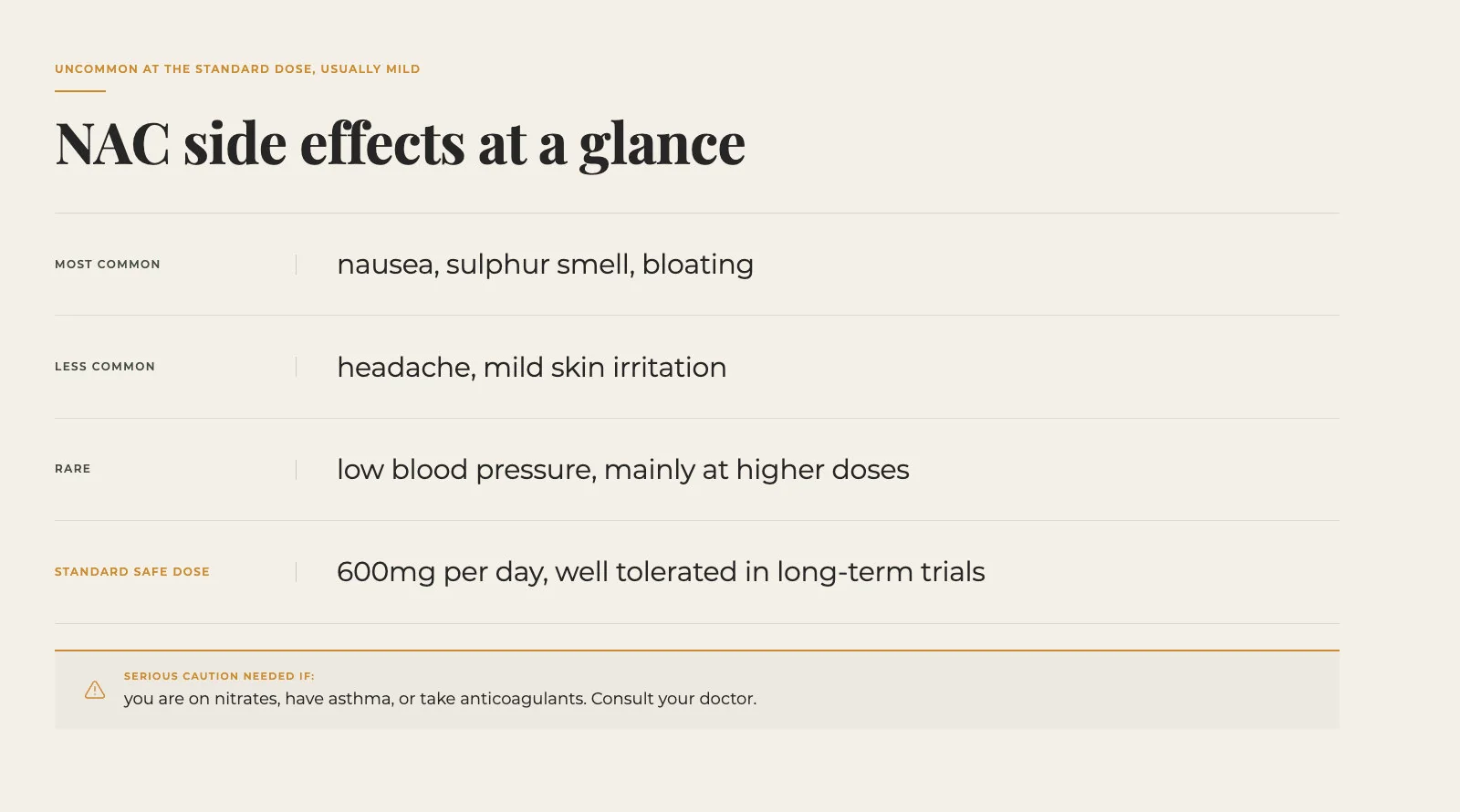
NAC side effects are uncommon at the standard 600mg daily dose and usually mild. The most common are mild nausea, a sulphur smell, and bloating, and they typically settle within a week or two. Last reviewed: June 2026.
NAC (N-acetyl cysteine) is one of the better-tolerated supplements on the market, with a safety record built on decades of clinical use. Side effects at standard supplemental doses are uncommon and generally mild. That said, they do occur in some people, and understanding what to expect and how to manage it is worth knowing before you start.
This article covers the known side effects of NAC, the doses at which they are most likely to occur, and when to exercise caution.
| Category | Details |
|---|---|
| Most common | Nausea, sulphur smell, bloating |
| Less common | Headache, mild skin irritation |
| Rare | Low blood pressure (mainly at higher doses) |
| Serious caution needed if | On nitrates, have asthma, taking anticoagulants |
| Standard safe dose | 600mg per day, well-tolerated in long-term trials |
Table of Contents
How Common Are NAC Side Effects?
At the standard supplemental dose of 600mg per day, adverse effects are infrequent. The BRONCUS trial, which ran for three years at 600mg daily, reported no significant safety signals (Decramer et al., The Lancet, 2005). Most people who experience any side effect report it at higher doses (1,200mg or above) or at the beginning of supplementation before the body adjusts.
At higher therapeutic doses used in clinical settings (up to 1,200mg twice daily), gastrointestinal side effects become more common. A 2021 review in Antioxidants reported nausea incidence of up to 23% at these higher doses, though much of this appears driven by NAC’s strong sulphur odour rather than the compound itself (Tenório et al., 2021). At 600mg daily, the rate is considerably lower.
NAC’s long history in clinical medicine, including its use as an IV treatment for paracetamol overdose since the 1970s, has generated a substantial safety dataset. At oral supplemental doses, it compares favourably with most pharmaceutical and supplement interventions.
Common Side Effects
Nausea and gastrointestinal discomfort
The most frequently reported side effect is mild nausea or gastrointestinal discomfort, particularly at the start of supplementation or at higher doses. This is not specific to NAC; it is common with amino acid supplements generally and tends to be transient.
How to manage it: take NAC with a small amount of food rather than on an empty stomach. If nausea persists at 600mg, reduce to 300mg for the first week and increase gradually. Most people who initially experience nausea find it resolves within the first 1–2 weeks.
The sulphur smell
NAC has a characteristic sulphurous smell, sometimes described as similar to rotten eggs or garlic. This is entirely normal and reflects the sulphur-containing structure of the molecule. It is not a sign of spoilage or a health concern. The smell intensifies with higher doses and can be noticeable in breath or urine after supplementation.
This is the single most commonly mentioned “side effect” in anecdotal reports, though it is not medically significant. Research suggests the odour itself contributes significantly to nausea, rather than the compound alone (Tenório et al., 2021). Taking NAC with food can reduce the intensity of any breath-related effect.
Bloating
Some people report mild bloating, particularly at higher doses. This is typically transient and resolves as the body adapts. Reducing dose temporarily and increasing fluid intake can help.
Less Common Side Effects
Headache
Headache has been reported at higher doses in a small number of clinical trial participants (Dodd et al., American Family Physician, 2009). The mechanism is not fully understood but may relate to NAC’s effects on nitric oxide signalling, which plays a role in vascular tone. If this occurs, reducing the dose usually resolves it.
Skin reactions
Rash or skin irritation is rare with oral NAC. It has been more commonly documented with intravenous NAC (used in clinical settings for paracetamol overdose), where allergic-type reactions such as flushing and rash occur in a small proportion of patients (Memorial Sloan Kettering). These reactions are not typically seen with oral supplementation.
Low blood pressure
NAC has mild vasodilatory effects via nitric oxide. In most people at supplemental doses this is clinically insignificant. Those already on blood pressure medications should discuss NAC supplementation with their prescriber, as there is a theoretical risk of additive hypotensive effect at higher doses.
High-Dose Considerations
Clinical research has used doses of 1,200–3,600mg per day in specific conditions. At these higher doses, side effects are more frequently reported and may include:
- More pronounced nausea and gastrointestinal discomfort
- Headache
- Fatigue (documented in some high-dose trials)
The AAFP notes that doses up to 1,200mg twice daily are generally well-tolerated, but gastrointestinal disturbance increases at the upper end of this range (Dodd et al., 2009). For most supplementation purposes, there is no evidence that doses above 600–1,200mg per day provide additional benefit, and they carry a higher likelihood of side effects.
Who Should Be Cautious
NAC is appropriate for most healthy adults, but certain groups should discuss it with a healthcare provider first:
- People with asthma: Intravenous NAC carries a risk of anaphylactoid reactions that can be severe in asthma patients. Oral NAC at supplemental doses is considered safer, but if you have asthma, consult your doctor before starting (Memorial Sloan Kettering).
- People taking nitroglycerin or other nitrate medications: NAC amplifies the vasodilatory effect of nitrates, potentially causing severe headache and low blood pressure. This combination should be avoided or only used under medical supervision.
- People on blood-thinning medications (anticoagulants): NAC has mild antiplatelet activity at higher doses. The clinical significance at supplemental doses is not well established, but caution is appropriate.
- People undergoing chemotherapy: NAC’s antioxidant effects may theoretically interfere with oxidative mechanisms used by some chemotherapy agents. Discuss with your oncologist.
- People with bleeding disorders: Given NAC’s mild antiplatelet activity, discuss with a specialist before supplementing.
- Pregnant or breastfeeding women: Insufficient safety data exist for supplemental doses during pregnancy. Dietary cysteine from food is appropriate, but supplements should be discussed with a midwife or GP.
- People with a history of kidney stones: Cysteine can contribute to cystine stone formation in those with cystinuria. NAC is generally fine for people without this condition but worth checking with a healthcare provider if you have a history of kidney stones.
NAC and Drug Interactions
Beyond nitroglycerin (mentioned above), other potential interactions worth knowing about:
- Activated charcoal: Used in some overdose scenarios, can reduce NAC absorption if taken simultaneously.
- Paracetamol: NAC is the antidote for paracetamol overdose. At supplemental doses alongside normal paracetamol use, there is no concern. Very high, regular paracetamol use depletes glutathione, making the combination potentially beneficial rather than problematic for liver support. For more on how the two compounds are related, see our guide on NAC vs glutathione.
- Immunosuppressants: NAC’s immune-modulating effects are relevant in some contexts. Discuss with a specialist if you are on immunosuppression.
- Pirfenidone: Case reports suggest potential light sensitivity when NAC is co-administered with pirfenidone, used for pulmonary fibrosis. Monitor and consult your prescriber if this applies to you.
NAC and Alcohol: What You Should Know
Alcohol metabolism generates acetaldehyde, a toxic compound the liver clears using glutathione. Regular drinking depletes glutathione stores, which contributes to the oxidative stress and liver strain associated with alcohol consumption.
NAC replenishes cysteine, the rate-limiting precursor to glutathione. A 2015 review in Oxidative Medicine and Cellular Longevity noted NAC’s potential to restore glutathione levels depleted by alcohol and reduce markers of liver oxidative stress (Lasram et al., 2015). Some small trials have also examined NAC in alcohol use disorder, with early signals around craving reduction, though the evidence is not yet robust enough to draw firm conclusions.
NAC is not a treatment for alcohol-related liver disease and does not make alcohol safer to consume. If you have concerns about liver health, speak with your GP.
One practical note on timing: taking NAC and alcohol close together is not advisable. NAC can amplify the vasodilatory effect of alcohol and may worsen flushing or headache in some people.
Is NAC Safe Long-Term?
Yes. At standard supplemental doses, NAC has a well-established long-term safety profile. The BRONCUS trial ran for three years at 600mg per day with no significant safety signals (Decramer et al., The Lancet, 2005). A 2021 review concluded that “an extensive review of multicentric medical records has shown that intravenous and oral NAC is associated with minimal side-effects” (Tenório et al., 2021).
NAC has been used as a prescription mucolytic for lung conditions in several European countries, where its effects on respiratory health and mucus clearance are well documented, all without evidence of long-term harm. As with any supplement, periodic reassessment of whether continued use is appropriate makes sense.
For a full discussion of NAC’s evidence base, dosage guidance, and benefits, see our NAC supplement guide. If you are looking for a high-quality NAC supplement, our NAC+ 600mg, now our improved formula with added selenium and molybdenum, is vegan-certified and provides the standard recommended daily dose.
Frequently Asked Questions
Why does NAC smell so bad?
NAC contains a sulphur atom as part of its chemical structure. This is what makes it effective as a cysteine donor. Sulphur-containing compounds have characteristic odours, and NAC is no different. The smell is normal, harmless, and does not indicate anything wrong with the product. It may be noticeable in breath or urine after taking it, particularly at higher doses.
Can NAC cause stomach upset?
Mild nausea or gastrointestinal discomfort can occur, particularly at the start of supplementation or at higher doses. Taking NAC with food usually helps. The effect tends to reduce or disappear after the first week or two as the body adjusts.
Can NAC cause an allergic reaction?
Allergic-type (anaphylactoid) reactions to NAC are rare and almost exclusively associated with intravenous administration in hospital settings. Symptoms can include rash, flushing, itching, and in severe cases wheezing or low blood pressure. With oral supplementation at standard doses, true allergic reactions are very uncommon. If you notice a rash or any unusual symptoms after starting NAC, stop taking it and speak with your GP.
Which NAC formulations are gentler on the stomach?
Capsule forms taken with food tend to be the best tolerated. Some people find effervescent or flavoured tablets easier to take because they mask the sulphur taste and odour, which contributes to nausea. Avoid taking NAC powder loose on an empty stomach, as this maximises both the taste and gastric irritation. Starting at a lower dose (300mg) for the first week can also help your body adjust.
How do I choose an NAC supplement with fewer side effects?
The formulation matters more than the brand for tolerability. Look for capsules rather than loose powder, stick to the standard 600mg dose, and take it with food. Avoid products that combine NAC with other ingredients that may cause their own gastric effects. A straightforward, single-ingredient NAC supplement at 600mg is the most widely studied and best-tolerated option. Our guide to choosing the best NAC supplement in the UK covers what to look for in more detail.
Can NAC make you feel worse before you feel better?
Some people report a brief period of mild discomfort (nausea, headache) in the first few days of starting NAC. This is not well-characterised in the research but is reported anecdotally. For most people it passes within 1–2 weeks. Starting at 300mg for the first week before moving to 600mg tends to reduce it significantly.
Does NAC thin the blood?
NAC has mild antiplatelet activity at higher doses, but at standard supplemental doses (600mg per day) this is not considered clinically significant for healthy adults. People on blood-thinning medications should discuss NAC use with their prescriber before starting.
Can I stop taking NAC suddenly?
Yes. There is no evidence that NAC causes dependence or that stopping suddenly causes withdrawal effects. Unlike medications that require gradual tapering, NAC can be started and stopped without a structured protocol.
References
- Decramer, M. et al. (2005). Effects of N-acetylcysteine on outcomes in chronic obstructive pulmonary disease (Bronchitis Randomized on NAC Cost-Utility Study, BRONCUS). The Lancet, 365(9470), 1552–1560.
- Tenório, M.C.D.S. et al. (2021). N-Acetylcysteine (NAC): Impacts on Human Health. Antioxidants, 10(6), 967. PMC
- Dodd, S. et al. (2009). N-acetylcysteine for antioxidant therapy: pharmacology and clinical utility. American Family Physician, 80(3), 265–269. AAFP
- Lasram, M.M. et al. (2015). N-acetylcysteine as an anti-inflammatory and neuroprotective agent. Oxidative Medicine and Cellular Longevity.
- Memorial Sloan Kettering Cancer Center. N-Acetylcysteine: Purported Benefits, Side Effects & More. MSKCC
- Mayo Clinic. Acetylcysteine (Oral Route). Mayo Clinic
This article is for informational purposes only and does not constitute medical advice. If you have a medical condition, take prescription medication, or are pregnant or breastfeeding, consult your GP or a qualified healthcare professional before starting any new supplement.
Find our guides useful? Add Epsilon Life as a preferred source on Google to see more of them in your search results.
Add to Google preferred sources