

The trillions of microorganisms living in your gut contain more than 100 times as many genes as the entire human genome. What you eat shapes that community more directly than almost any other lifestyle factor.
The microbiome diet is not a trend. It is essentially what healthy human populations have always eaten: a wide variety of plants, fermented foods, and minimal processing. Modern research has made the underlying mechanisms specific enough to translate into clear, practical guidance.
If you want to improve your gut microbiome through diet, here is what the research actually recommends.
Table of Contents
What Is the Microbiome Diet?
The microbiome diet is an eating pattern designed to support the diversity and function of the gut microbiome: the trillions of bacteria and other microorganisms living in your digestive tract.
Unlike elimination diets, the microbiome diet is largely about addition: adding more of the foods that feed beneficial bacteria, while reducing the foods that disrupt them. It is not a strict protocol with a start and end date. It is a long-term eating pattern.
If you are dealing with specific digestive symptoms — bloating, irregular bowels, or persistent discomfort — and want a more targeted approach, see our guide to the gut healing diet.
The Core Principles
1. Eat 30 different plant foods per week
This is the most evidence-backed target in microbiome research. The American Gut Project — a citizen science study involving over 10,000 participants — found that people eating 30 or more different plant foods per week had significantly more diverse gut microbiomes than those eating fewer than 10 (McDonald et al., mSystems, 2018).
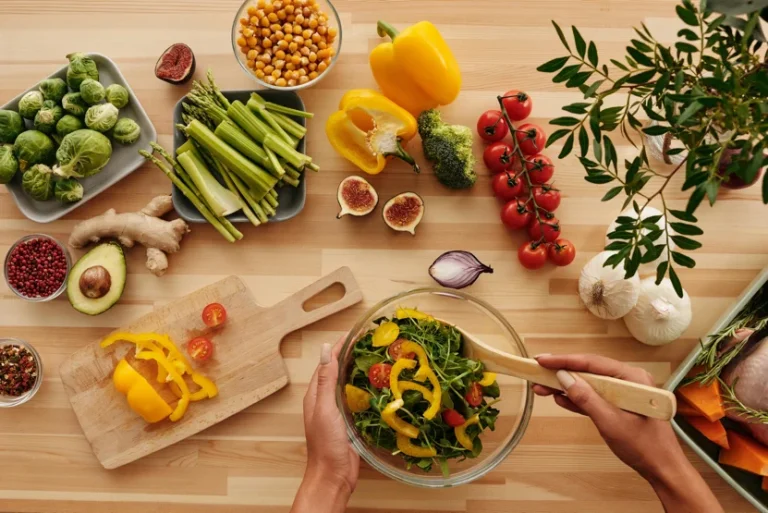
Plant foods include vegetables, fruits, legumes, whole grains, nuts, seeds, and herbs. Variety matters more than quantity of any single food. Two different coloured bell peppers count as two plants. Rotating your legumes (lentils one day, chickpeas the next) adds up quickly.
For a full breakdown of what counts as a plant, common mistakes, and easy ways to add variety without extra cooking, see our dedicated guide to 30 plants a week.
2. Prioritise fibre-rich, prebiotic foods
Prebiotic fibre is the specific type that feeds beneficial bacteria like Bifidobacterium and Lactobacillus. It is found in:
- Garlic, onions, leeks, and shallots
- Jerusalem artichokes
- Oats and barley
- Green bananas and under-ripe plantain
- Asparagus and chicory root
Resistant starch — found in cooked-then-cooled potatoes, rice, and pasta — also acts as a prebiotic and is particularly effective at feeding butyrate-producing bacteria. Butyrate is the main fuel for colon cells and plays a key role in maintaining the gut barrier.
3. Eat fermented foods daily
Fermented foods contain live microorganisms that may add directly to the gut’s bacterial community. A randomised trial in Cell (Wastyk et al., 2021) found that a high-fermented food diet increased microbiome diversity and reduced 19 markers of inflammation — more than a high-fibre diet alone.
Beyond adding live bacteria, fermented foods also create conditions that help your existing gut flora grow and diversify. This may partly explain why the Cell study found a high-fermented diet outperformed high-fibre alone for microbiome diversity: it is not just about what you introduce, but the environment you create.
The most accessible fermented foods in the UK are live yoghurt, kefir, sauerkraut, kimchi, and miso. For sauerkraut and kimchi to contain live bacteria, they need to be unpasteurised and refrigerated, not the shelf-stable jars. For a deeper look at the evidence, see our article on fermented foods and gut health.
4. Include polyphenol-rich foods
Polyphenols — compounds found in berries, dark chocolate, olive oil, green tea, and coffee — act as a prebiotic for certain beneficial bacteria. They pass largely undigested to the large intestine, where bacteria convert them into metabolites with anti-inflammatory properties.
Extra virgin olive oil is particularly well-studied. Mediterranean diet research consistently associates olive oil consumption with greater microbiome diversity and lower inflammatory markers.
5. Reduce ultra-processed foods
Ultra-processed foods — those containing industrial additives not found in home cooking — are consistently associated with lower microbiome diversity. Common emulsifiers (carrageenan, polysorbate-80, carboxymethylcellulose) can disrupt the protective mucus layer of the gut. Artificial sweeteners alter gut bacteria in ways linked to impaired glucose regulation.
The goal is not elimination. It is reducing the proportion of ultra-processed foods in your overall pattern. For a detailed breakdown of which foods cause the most damage, see our article on the worst foods for gut health.
Microbiome Diet Food List
A practical reference for microbiome-supportive eating, organised by function:
Prebiotic foods (feed beneficial bacteria)
- Garlic, onions, leeks, shallots, asparagus, chicory root
- Jerusalem artichokes
- Oats, barley, and rye
- Green bananas and under-ripe plantain
- Lentils, chickpeas, black beans, and kidney beans
- Cooked-then-cooled potatoes, rice, and pasta (resistant starch)
Fermented foods (add and support live bacteria)
- Live yoghurt and kefir
- Unpasteurised sauerkraut and kimchi (refrigerated)
- Miso paste and tempeh
- Kombucha
- Sourdough bread
Polyphenol-rich foods (feed specific beneficial strains)
- Blueberries, blackberries, raspberries, and pomegranate
- Extra virgin olive oil
- Dark chocolate (70%+)
- Green tea and black coffee
High-diversity plant foods (count towards your 30 per week)
- All vegetables — each variety counts separately
- All fruits
- Whole grains: oats, barley, rye, quinoa, brown rice, buckwheat
- Nuts and seeds: walnuts, almonds, flaxseed, chia, pumpkin seeds
- Herbs and spices: each one counts as a separate plant food
Foods to limit
- Ultra-processed foods containing emulsifiers and industrial additives
- Artificial sweeteners (aspartame, sucralose, saccharin)
- High-sugar foods and refined carbohydrates
A Sample Day on the Microbiome Diet
A microbiome-supportive day does not have to be complicated:
- Breakfast: Oat porridge with berries, flaxseed, and a tablespoon of live yoghurt
- Lunch: Lentil soup with a variety of vegetables; slice of rye bread
- Snack: Handful of mixed nuts and an apple
- Dinner: Grilled salmon with roasted broccoli, sweet potato, and a sauerkraut side
- Drinks: Water, green tea, or black coffee
That day reaches roughly 12–15 different plant foods. Adding variety throughout the week (different vegetables, rotating legumes, switching up grains) gets you to 30.
The Gut-Brain Connection
The microbiome’s influence extends well beyond digestion. Around 90% of the body’s serotonin is produced in the gut, not the brain. The gut and brain are linked via the vagus nerve, a bidirectional communication system that transmits signals in both directions.
A comprehensive review in Physiological Reviews (Cryan et al., 2019), covering hundreds of studies, found consistent associations between gut microbiome composition and mood, anxiety, cognitive function, and stress reactivity. Disruptions to gut bacteria were repeatedly linked with changes in psychological outcomes, while interventions that supported microbiome diversity showed measurable effects on mental wellbeing.
For people over 40, this is worth paying attention to. Microbiome diversity tends to decline with age, and the same period is often marked by increased stress, sleep changes, and mood shifts. Research suggests that supporting gut bacteria through diet may play a role in these outcomes, though the science here is still developing and diet is one factor among many.
For a deeper look at how the gut and brain communicate, see our guide to the gut-brain axis.
Should You Take a Probiotic Supplement?
Diet is the foundation. But probiotic supplements can complement a microbiome diet, particularly if your gut has been disrupted by antibiotics, illness, or a period of poor diet.
The key is strain specificity — different probiotic strains have different effects. Lactobacillus plantarum, Lactobacillus rhamnosus, Lactobacillus casei, and Saccharomyces boulardii are among the most studied for general gut health.
Our Biome Bliss supplement contains all six of the core researched strains in a fermented format, delivering live bacteria alongside the prebiotic and postbiotic compounds produced during fermentation. It is designed to work alongside a microbiome-supportive diet, not replace it.
For more on the compounds produced during fermentation, see our article on postbiotics.
How Long Before You Notice Results?
Changes in the microbiome can be measured within days of a dietary shift. How quickly you feel a difference varies. Bloating and bowel regularity often improve within 1–2 weeks of increasing fibre and fermented foods. Longer-term benefits — improved immune function, mood, and energy — typically become more noticeable after 4–8 weeks of consistent changes.
Introduce high-fibre foods gradually if you are not used to them. Rapid increases can cause temporary gas and bloating as your bacteria adjust. This is normal and passes.
FAQ
What is the difference between prebiotics and probiotics?
Prebiotics are the food that feeds beneficial gut bacteria — mainly certain types of fibre that reach the large intestine undigested. Probiotics are live microorganisms themselves, either from fermented foods or supplements. Think of it this way: probiotics are the bacteria, prebiotics are what keeps them alive and thriving. Combining them — eating prebiotic-rich foods alongside fermented foods — is more effective than either alone.
Is the microbiome diet the same as a plant-based diet?
No, though they overlap. A microbiome diet does not require eliminating animal products — it prioritises plant variety and fermented foods. Research shows omnivores with high plant diversity have healthier microbiomes than vegans with low plant variety.
Does eating more fibre cause bloating?
It can, especially initially. Increased fibre feeds bacteria that produce gas as a byproduct. This usually settles within 1–2 weeks as the microbiome adapts. Introducing fibre gradually and staying well hydrated helps manage this.
How many plant foods should I eat per week?
Research from the American Gut Project points to 30 different plant foods per week as the threshold associated with significantly higher microbiome diversity. Counting everything — vegetables, fruits, grains, legumes, nuts, seeds, herbs — makes this achievable. See our full guide to 30 plants a week for what counts, what doesn’t, and practical ways to track it.
Is probiotic yoghurt enough for gut health?
Live yoghurt is a useful addition to a microbiome diet, but it contains limited bacterial strains. As a single intervention, it is unlikely to make a significant difference if the rest of your diet is low in fibre and plant variety. Diet pattern is the main driver.
Can children follow a microbiome diet?
The principles — high plant variety, fibre, fermented foods, minimal ultra-processed food — are appropriate for all ages. Children’s gut microbiomes are more responsive to dietary change than adults’, making early dietary habits particularly important for long-term gut health.
References
- McDonald D et al. American Gut: an Open Platform for Citizen Science Microbiome Research. mSystems. 2018;3(3). PubMed
- Wastyk HC et al. Gut-microbiota-targeted diets modulate human immune status. Cell. 2021;184(16):4137–4153. PubMed
- Cryan JF et al. The Microbiota-Gut-Brain Axis. Physiological Reviews. 2019;99(4):1877–2013. PubMed
- Flint HJ et al. The role of the gut microbiota in nutrition and health. Nature Reviews Gastroenterology & Hepatology. 2012;9:577–589. PubMed
This article is for informational purposes only and does not constitute medical advice. Speak to your GP or a registered dietitian if you have a digestive health condition or are making significant dietary changes.
Find our guides useful? Add Epsilon Life as a preferred source on Google to see more of them in your search results.
Add to Google preferred sources