



Most vitamin D supplements contain one ingredient. Epsilon Life Vitamin D3K2 contains five, and each one is there for a specific reason backed by published research.
This article explains every ingredient in Epsilon Life Vitamin D3K2, why we chose each dosage, and what distinguishes this supplement from the hundreds of D3 products available in the UK. If you’re comparing vitamin D3 and K2 supplements, this is the detail that matters.
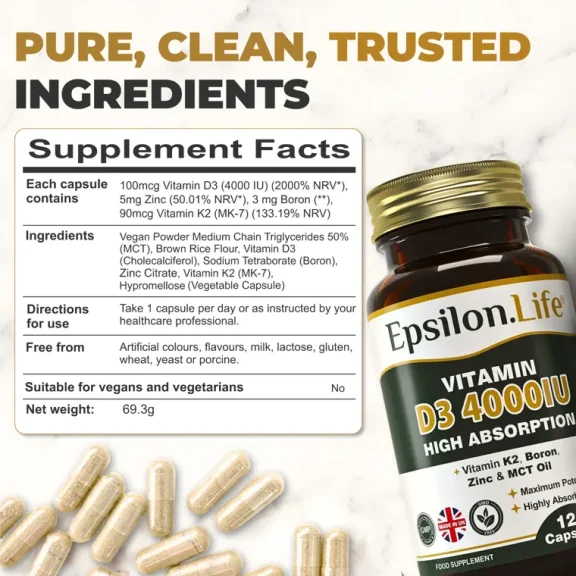
Vitamin D3: 4,000 IU cholecalciferol
Epsilon Life Vitamin D3K2 uses cholecalciferol (D3), the same form your skin produces from sunlight. D3 is more effective at raising and maintaining serum 25(OH)D levels than ergocalciferol (D2), which is the plant-derived form found in some cheaper supplements.
The dose of 4,000 IU is the tolerable upper intake level set by the European Food Safety Authority for adults, including pregnant and lactating women. This is a high-strength vitamin D dose, well above the NHS minimum recommendation of 400 IU, and appropriate for adults who want to maintain optimal levels year-round rather than simply avoid deficiency.
Why 4,000 IU rather than 1,000 or 2,000? Because in the UK, most adults get very little vitamin D from sunlight between October and March. UVB radiation at British latitudes is too weak to trigger synthesis during those months. Even in summer, factors like indoor lifestyles, sunscreen use, and darker skin tones reduce production significantly. A systematic review and meta-analysis published in European Journal of Nutrition (2023) examining long-term supplementation at 3,200–4,000 IU daily found that the absolute risk of hypercalcaemia was very low (approximately 4 cases per 1,000 individuals) and the dose remains within the EFSA-established safe upper limit for healthy adults.
For context on what vitamin D does in the body and why deficiency is so common, see our guide to the health benefits of vitamin D. For adults over 65, who convert D3 less efficiently, we have a dedicated guide to vitamin D for seniors.
Understanding vitamin D dosage: what 25 µg actually means
If you’ve compared vitamin D supplements in the UK, you’ve probably noticed that some labels list the dose in micrograms (µg) and others in International Units (IU). They’re measuring the same thing in different units. The conversion is straightforward: 1 µg of vitamin D = 40 IU.
Most supermarket and high-street vitamin D supplements in the UK contain 25 µg per tablet. That’s 1,000 IU — enough to meet the NHS minimum recommendation of 10 µg (400 IU) with some margin, but well below what research suggests is optimal for adults who want to maintain levels in the 75–100 nmol/L range year-round.
| Dose (µg) | Dose (IU) | Context |
|---|---|---|
| 10 µg | 400 IU | NHS minimum for all UK adults (Oct–Mar) |
| 25 µg | 1,000 IU | Most UK high-street supplements (Boots, Holland & Barrett) |
| 50 µg | 2,000 IU | Common mid-strength dose |
| 100 µg | 4,000 IU | Epsilon Life Vitamin D3K2 — EFSA tolerable upper limit |
Is 25 µg enough? For preventing severe deficiency in otherwise healthy adults with some sun exposure, probably. For correcting an existing insufficiency or maintaining optimal levels through winter? The research suggests it often isn’t. A study published in the American Journal of Clinical Nutrition (2012) found that 1,000 IU daily was insufficient to raise serum 25(OH)D above 75 nmol/L in the majority of participants during winter, while 4,000 IU achieved this in most cases without safety concerns.
Epsilon Life Vitamin D3K2 provides 100 µg (4,000 IU) — four times the typical high-street dose — within the EFSA safe upper limit for adults. If you’ve been taking a 25 µg supplement and not noticed a difference, the dose may simply be too low for your needs.
Vitamin K2: 90mcg MK-7 (all-trans)
Vitamin K2 directs calcium where it’s needed (into bones and teeth) and away from where it causes harm, such as arterial walls. When you supplement vitamin D at a meaningful dose, your body absorbs more calcium from food. Without K2, that calcium can end up in soft tissues rather than the skeleton. The two nutrients are designed to work together, and supplementing D3 without K2 is, at best, an incomplete strategy.
Epsilon Life Vitamin D3K2 uses menaquinone-7 (MK-7), which is the most bioavailable form of K2. It has a half-life of approximately 72 hours, compared with just 1–2 hours for K1, meaning a single daily dose maintains consistent blood levels. MK-7 also demonstrates superior ability to activate osteocalcin (a bone-building protein) and matrix Gla protein (which prevents arterial calcification) compared with shorter-chain forms like MK-4.
The all-trans distinction matters. MK-7 exists in two geometric forms: all-trans and cis. Only the all-trans form is biologically active. Research published in BioFactors (2022) confirmed that trans MK-7 has substantially higher carboxylative efficacy (the ability to activate vitamin K-dependent proteins) while cis MK-7 showed minimal activity, estimated at roughly 1% of the trans form’s potency.
This is a real problem in the supplement market. An analysis of thirty-eight commercial K2 products found that more than two-thirds failed to meet label claims for MK-7 content and isomeric purity. In some products, cis/trans isomers exceeded the all-trans content by up to 3.7 times. In practice, this means you could be taking a supplement that lists 100mcg of K2 on the label but delivers a fraction of that in biologically active form.
Epsilon Life Vitamin D3K2 uses all-trans MK-7, sourced through a fermentation process (the same method that produces MK-7 naturally in natto). Fermentation-derived MK-7 contains effectively 100% trans isomers, unlike chemically synthesised K2 which produces mixtures of cis and trans forms. For more on what K2 does in the body, see our article on the health benefits of vitamin K2.
Zinc citrate: 5mg
Zinc plays a direct role in how your body uses vitamin D. It is required for the proper function of vitamin D receptors (VDRs), the proteins on cell surfaces that allow cells to recognise and respond to active vitamin D. Without adequate zinc, vitamin D signalling at the cellular level is impaired, even when blood levels of D appear normal.
Beyond its role in D metabolism, zinc is independently essential for immune function. It supports natural killer cell activity, T-cell regulation, and the maintenance of physical tissue barriers that form the body’s first line of defence. Research published in The Journal of Nutritional Biochemistry (2022) found that vitamin D3 and zinc in combination suppressed inflammatory interferon-γ production more effectively than either nutrient alone, and boosted the differentiation of regulatory T cells, suggesting genuine synergy rather than simple co-administration.
Epsilon Life Vitamin D3K2 includes 5mg of zinc citrate as a complementary dose, not a standalone zinc supplement. The UK Reference Nutrient Intake is 7mg for women and 9.5mg for men, and most people get 5–10mg from their diet. The 5mg addition is calibrated to close common shortfalls without risking the copper displacement that occurs at higher supplemental doses (above 25mg daily long-term). For more detail on how zinc, vitamin D and magnesium interact, see our article on taking vitamin D with zinc and magnesium.
Boron: 3mg
Boron is the least well-known ingredient in Epsilon Life Vitamin D3K2, but the evidence for its inclusion at 3mg is solid. A narrative review published in the Journal of Trace Elements in Medicine and Biology (2020), examining 11 eligible studies, concluded that 3mg/day of boron is demonstrably useful for supporting bone mineral density, well below the EFSA upper limit of 10mg.
Boron’s mechanism of action is relevant to this specific formula. It influences the metabolism of both vitamin D and steroid hormones (including oestradiol and testosterone) by inhibiting the enzymes that degrade them. Supplementation has been shown to reduce urinary excretion of calcium and magnesium, effectively helping the body retain two minerals that are critical for bone health. In vitamin D-deficient models, boron supplementation alleviates the disruptions in mineral metabolism that D deficiency causes.
There isn’t a UK RNI for boron because it hasn’t been classified as essential, as the evidence isn’t there yet for a formal requirement. But the functional data is strong enough that we consider it a meaningful addition, particularly given the formula’s focus on bone health and calcium metabolism. For a deeper look at boron’s role alongside vitamin D, see our guide to boron benefits.
MCT oil as the carrier
Vitamins D3 and K2 are both fat-soluble, so they need dietary fat present for absorption. Many supplements use soybean oil or sunflower oil as a carrier. Epsilon Life Vitamin D3K2 uses MCT (medium-chain triglyceride) oil derived from coconut.
MCT oil has a practical advantage: it doesn’t require bile salts for absorption, meaning it passes directly from the GI tract to the hepatic portal system. This makes the formula less dependent on the presence of a fatty meal for absorption consistency. If you take your D3 in the morning with just coffee or a light breakfast, MCT as the carrier ensures the fat-soluble nutrients have a reliable absorption pathway regardless of what you’ve eaten.
MCT also provides excellent chemical stability, keeping the active ingredients intact over the product’s shelf life, an underappreciated factor in supplement quality.
What we left out
Formulation choices are as much about what you exclude as what you include. Epsilon Life Vitamin D3K2 does not contain magnesium, even though magnesium is essential for vitamin D activation. The reason is dosage: a meaningful magnesium dose (300–400mg elemental) won’t fit in a single capsule alongside the other ingredients without making the capsule impractically large or requiring multiple pills. Rather than including a token 50mg that would have no real effect, we offer Magnesium Glycinate as a separate supplement at a proper dose.
We also don’t include calcium. Despite D3 and K2’s roles in calcium metabolism, most UK adults get adequate calcium from food (dairy, fortified plant milks, leafy greens). Supplemental calcium at high doses has been associated with cardiovascular concerns in some research, and the D3 + K2 combination already optimises how your body handles the calcium you get from your diet. Adding it to the pill would be redundant for most people and potentially counterproductive.
There are no bulking agents, artificial fillers, or unnecessary excipients. The capsule contains the five active ingredients listed above and nothing else.
How to take it
One capsule daily, ideally in the morning or at lunchtime with food. The MCT oil base means absorption doesn’t strictly require a fatty meal, but taking it with food is still best practice for consistency and to avoid any minor stomach sensitivity on an empty stomach.
If you’re also taking our Magnesium Glycinate, take the magnesium in the evening. Spacing the two supplements by 4–6 hours avoids any competition between zinc and magnesium for absorption transporters, and evening magnesium supports sleep quality. The routine is simple: D3K2 at breakfast, magnesium before bed.
Do not exceed 4,000 IU daily without medical supervision, particularly if you take medications that affect calcium metabolism (such as thiazide diuretics). If you’re taking warfarin or other vitamin K-dependent anticoagulants, consult your doctor before taking any K2 supplement, as K2 can affect INR levels.
Who is this supplement for?
Epsilon Life Vitamin D3K2 is designed for adults in the UK who want a comprehensive, high-strength vitamin D3 and K2 supplement that addresses the full chain of D3 metabolism: not just the D3 itself, but the co-factors that determine whether your body can actually use it.
It’s particularly relevant for adults with limited sun exposure (most people in the UK for at least half the year), anyone concerned about bone health, women approaching or going through menopause (when bone density loss accelerates), people who want immune support beyond the baseline (vitamin D, zinc and K2 all contribute to immune regulation), and anyone who has previously taken vitamin D alone without noticing a difference, which often indicates that co-factor deficiencies were limiting the benefit.
It is not suitable for children, and we recommend speaking with your GP before use if you are pregnant, breastfeeding, or taking blood-thinning medication. The formula is not certified vegan. It is manufactured to GMP and BRCGS standards.
Frequently asked questions
Is 4,000 IU of vitamin D safe to take daily?
Yes, for healthy adults. 4,000 IU is the tolerable upper intake level set by EFSA. A 2023 systematic review found the absolute risk of hypercalcaemia at this dose was approximately 4 per 1,000 individuals, very low but not zero. Vitamin D toxicity typically requires sustained doses well above 10,000 IU. If you have a condition affecting calcium metabolism or take medications like thiazide diuretics, consult your GP before supplementing at this level.
What is 25 µg of vitamin D in IU?
25 µg of vitamin D equals 1,000 IU. The conversion is 1 µg = 40 IU. Most UK high-street vitamin D supplements contain 25 µg (1,000 IU) per tablet, which is above the NHS minimum of 10 µg (400 IU) but below the EFSA tolerable upper limit of 100 µg (4,000 IU). Epsilon Life Vitamin D3K2 provides 100 µg (4,000 IU) per capsule.
What does “all-trans” K2 mean and why does it matter?
MK-7 (the form of vitamin K2 used in this supplement) exists in two geometric forms: all-trans and cis. Only the all-trans form is biologically active; the cis form has roughly 1% of the potency. Many commercial K2 products contain significant amounts of the cis isomer, sometimes exceeding the all-trans content. The MK-7 in Epsilon Life Vitamin D3K2 is fermentation-derived, which produces effectively 100% all-trans K2.
Why is the zinc dose only 5mg?
The 5mg dose in Epsilon Life Vitamin D3K2 is intentionally complementary rather than standalone. Most UK adults get 5–10mg of zinc from food, and the RNI is 7–9.5mg depending on sex. The 5mg addition closes the common shortfall without risking the copper displacement that occurs with higher supplemental zinc doses (above 25mg daily). If you need a higher therapeutic dose of zinc, this should be guided by a healthcare practitioner.
Can I take this if I’m already taking a multivitamin?
Check your multivitamin’s vitamin D and zinc content first. If your multivitamin contains 400–1,000 IU of D3 and some zinc, adding Epsilon Life Vitamin D3K2 could push total intake higher than intended. In most cases, this formula is designed to replace the D3 and zinc components of a multivitamin, not stack on top of them. If you’re unsure, add up the total IU of vitamin D from all sources and stay at or below 4,000 IU unless advised otherwise by your GP.
Do I need to take this with food?
The MCT oil carrier provides a fat source for absorption, so the supplement works even without a fatty meal. That said, taking it with food, particularly breakfast or lunch, is still good practice for consistency and to minimise any chance of mild stomach discomfort. Avoid taking it late in the evening, as vitamin D may interfere with melatonin signalling in some people. For the full picture of how vitamin D affects sleep quality and timing, see our guide to vitamin D and sleep.
Is this supplement suitable for vegans?
Epsilon Life Vitamin D3K2 is not certified vegan. If you require a vegan-certified supplement, our Magnesium Glycinate and NAC+ are both vegan-certified.
What is the best vitamin D3 and K2 supplement in the UK?
The best D3 and K2 supplement should contain meaningful doses of both nutrients (not token amounts), use the all-trans form of MK-7, include a fat-soluble carrier for absorption, and ideally provide complementary co-factors like zinc. Many products on the UK market use low-dose D3 (400–1,000 IU), unspecified K2 isomers, or bulk the capsule with fillers. Epsilon Life Vitamin D3K2 was designed to address each of those gaps: 4,000 IU D3, 90mcg all-trans MK-7, zinc citrate, boron and MCT oil in a single capsule. Regardless of which product you choose, check the label for D3 dose, K2 form and isomeric purity, and whether a carrier oil is included.
How does this compare to buying vitamin D and K2 separately?
You can supplement D3 and K2 separately, but combining them ensures consistent co-administration. The practical advantage of Epsilon Life Vitamin D3K2 as a 5-in-1 formula is that you get the D3, K2, zinc, boron and carrier fat in a single capsule taken once daily, removing the compliance burden of juggling multiple bottles. The formulation also means the ratios are calibrated to work together, rather than relying on guesswork with separate products.

View Epsilon Life Vitamin D3K2 – high-strength 4,000 IU D3, 90mcg all-trans MK-7, zinc citrate, boron and MCT oil in a single daily capsule. No fillers. Made in the UK to GMP and BRCGS standards.
References
- EFSA Panel on Nutrition. Scientific opinion on the tolerable upper intake level for vitamin D. EFSA Journal. 2023;21(8):e08145. doi:10.2903/j.efsa.2023.8145
- Zittermann A, Trummer C, Theiler-Schwetz V, Pilz S. Long-term supplementation with 3200 to 4000 IU of vitamin D daily and adverse events: a systematic review and meta-analysis of randomised controlled trials. European Journal of Nutrition. 2023;62:1833–1844. doi:10.1007/s00394-023-03124-w
- Cirilli I, et al. Carboxylative efficacy of trans and cis MK7 and comparison with other vitamin K isomers. BioFactors. 2022;48(5):1138–1147. doi:10.1002/biof.1844
- Marles RJ, et al. Identification of cis/trans isomers of menaquinone-7 in food as exemplified by dietary supplements. Food Chemistry. 2018;242:76–81. doi:10.1016/j.foodchem.2017.09.025
- Rondanelli M, et al. Pivotal role of boron supplementation on bone health: a narrative review. Journal of Trace Elements in Medicine and Biology. 2020;62:126577. doi:10.1016/j.jtemb.2020.126577
- Pizzorno L. Nothing Boring About Boron. Integrative Medicine. 2015;14(4):35–48. PMC4712861
- Uwitonze AM, Razzaque MS. Role of Magnesium in Vitamin D Activation and Function. The Journal of the American Osteopathic Association. 2018;118(3):181–189. doi:10.7556/jaoa.2018.037
- Wessels I, Maywald M, Rink L. Zinc as a Gatekeeper of Immune Function. Nutrients. 2017;9(12):1286. doi:10.3390/nu9121286
- Schmitt AK, Puppa MA, Wessels I, Rink L. Vitamin D3 and zinc synergistically induce regulatory T cells and suppress interferon-γ production in mixed lymphocyte culture. The Journal of Nutritional Biochemistry. 2022;102:108942. doi:10.1016/j.jnutbio.2022.108942
- Public Health England. SACN Vitamin D and Health Report. 2016.
- Gallagher JC, Sai A, Templin T, Smith L. Dose response to vitamin D supplementation in postmenopausal women: a randomized trial. Annals of Internal Medicine. 2012;156(6):425–437. doi:10.7326/0003-4819-156-6-201203200-00005
This article is for informational purposes only and does not constitute medical advice. If you suspect a nutritional deficiency, speak with your GP or a qualified healthcare practitioner before starting supplementation.
Find our guides useful? Add Epsilon Life as a preferred source on Google to see more of them in your search results.
Add to Google preferred sources